Since 12 August 2026, the EU Packaging and Packaging Waste Regulation — Regulation (EU) 2025/40, better known as PPWR — has applied across the European Union. It replaces Directive 94/62/EC, which had been in place since 1994. If you ship goods from Ukraine to EU business partners or sell directly to consumers in Poland, Germany or elsewhere in the EU, this matters: the regulation covers all packaging, whatever the material, and applies to goods from third countries just as it does to EU-made products.
This guide explains which PPWR requirements already apply, which come later, who they affect and what you can adjust in your packaging now. All dates and figures come from the official text of the regulation on EUR-Lex, with article numbers in brackets so you can check them.
What PPWR is and why it matters for exporters outside the EU
PPWR is a regulation, not a directive. The old directive was transposed differently in each country; the regulation is binding in its entirety and directly applicable in all 27 Member States (Art. 71). It covers the whole packaging life cycle: substances, recyclability, minimisation, labelling, extended producer responsibility (EPR), and waste collection and recycling (Art. 1).
The core rule is in Article 4: packaging may only be placed on the EU market if it complies with the regulation, and Member States may not block packaging that meets the requirements of Articles 5 to 12. In other words, your box, tape, void fill and label are now checked as part of the product.
Which role do you play under PPWR?
- You sell to an EU importer. An importer is a person established in the EU who places packaging from a third country on the market (Art. 3(1)(17)). Before doing so, the importer must make sure the manufacturer has carried out the conformity assessment, drawn up the technical documentation and labelled the packaging (Art. 18(2)). Expect your partner to ask you for packaging data.
- You sell directly to end users in the EU through your own web shop or a marketplace. A seller established in a third country that makes packaged products available for the first time in a Member State directly to end users, including by distance contract, is a "producer" (Art. 3(1)(15)(d)). Registration and EPR obligations follow from this.
- You supply packaging or packaging materials to an EU manufacturer. Suppliers must give the manufacturer all information and documentation needed to demonstrate conformity (Art. 16).
Key PPWR dates at a glance
Most design requirements do not apply immediately. Many dates follow the formula "1 January 2030 or a set period after the Commission's delegated or implementing acts enter into force, whichever is the latest", so final deadlines may move later.
| Date | What happens | Article |
|---|---|---|
| 11 Feb 2025 | Regulation entered into force (published in the Official Journal on 22 Jan 2025) | Art. 71 |
| 12 Aug 2026 | Regulation applies; PFAS limits for food-contact packaging | Art. 71, Art. 5(5) |
| 12 Aug 2028* | Harmonised material-composition label, including on e-commerce packaging | Art. 12(1) |
| 1 Jan 2030* | All packaging recyclable within grades A, B or C; weight and volume minimised; max. 50% empty space in transport and e-commerce packaging; minimum recycled content in plastic; re-use targets | Arts. 6, 7, 10, 24, 29 |
| 1 Jan 2035* | "Recycled at scale" requirement added | Art. 6(2)(b) |
| 1 Jan 2038 | Only packaging with recyclability grade A or B allowed | Art. 6(3) |
| 1 Jan 2040 | Higher recycled-content shares for plastic | Art. 7(2) |
* or later, depending on when the relevant Commission acts enter into force.
Recyclability grades A, B and C
Article 6 states that all packaging placed on the EU market must be recyclable. Recyclability is expressed in grades A, B or C (Art. 6(3), Annex II, Table 3), based on a design-for-recycling assessment per packaging unit, by weight: grade A is 95% or more, B is 80% or more, C is 70% or more. Below 70%, packaging is technically non-recyclable and cannot be placed on the market. Grades A–C are required from 1 January 2030 (or 24 months after the delegated acts, if later); from 1 January 2038, only A or B. The detailed criteria per packaging category are due in delegated acts by 1 January 2028 (Art. 6(4)), so nobody can give your box an exact grade yet.
The direction is clear, though. Packaging is assessed with all its components, and tape, labels and other elements must not hinder the recyclability of the main body (Art. 6(9)). A mono-material paper solution — box, tape and void fill all in the paper/cardboard stream — fits that direction well. Examples are water-activated kraft tape instead of polypropylene tape and kraft paper for wrapping. We compared paper and plastic tape in kraft tape vs regular tape.
Note that compliance is assessed for the specific packaging as a whole, by the manufacturer, under the regulation's procedure. No roll of tape makes a parcel "PPWR-compliant" on its own.
Minimisation and the 50% empty-space rule
By 1 January 2030, manufacturers and importers must ensure that packaging weight and volume are reduced to the minimum necessary for its function (Art. 10(1)). Packaging designed only to increase the perceived volume — double walls, false bottoms, unnecessary layers — is not allowed (Art. 10(2)).
For online sellers, Article 24 is the key one. Economic operators who fill grouped, transport or e-commerce packaging must keep the empty space ratio at a maximum of 50% (Art. 24(1)), from 1 January 2030 or three years after the calculation methodology enters into force, whichever is later. Empty space is the difference between the volume of the outer box and the volume of the sales packaging inside (Art. 24(3)).
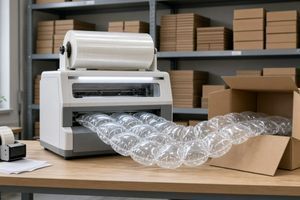
A crucial detail: space filled with paper cuttings, air cushions, bubble wrap, foam or polystyrene chips counts as empty space (Art. 24(3)). Void fill does not help you meet the ratio; right-sizing the box does. Our guide to sizing corrugated boxes for e-commerce walks through the calculation, and stocking several sizes of cardboard boxes instead of one "universal" box is the easiest first step.
Void fill still protects the product. The methodology, due by 12 February 2028, must take into account fragile and irregularly shaped products and multi-item parcels (Art. 24(2)). See air cushions vs paper void fill and our void fill range. Where sales packaging is used as e-commerce packaging, the 50% rule does not apply, but Article 10 still does (Art. 24(5)).
Recycled content in plastic packaging
Article 7 applies only to plastic parts of packaging. From 1 January 2030 (or three years after the calculation methodology, if later), they must contain minimum post-consumer recycled content, averaged per plant and year: 30% for PET contact-sensitive packaging (except single-use beverage bottles), 10% for contact-sensitive packaging from other plastics, 30% for single-use plastic beverage bottles and 35% for other plastic packaging, such as mailer bags and films. From 1 January 2040, the figures rise to 50%, 25%, 65% and 65% (Art. 7(2)). Plastic parts under 5% of the total weight of the packaging unit are excluded (Art. 7(5)(b)).
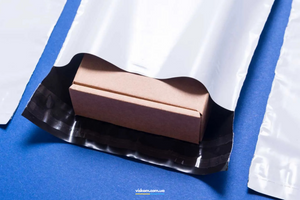
If you ship in polyethylene mailers or film, ask your suppliers about recycled content now. Paper cushioning such as Honeycomb kraft paper or Bubble Paper is outside the scope of Article 7. To plan consumption, see how much honeycomb paper you need per order.
Re-use targets: do they cover cardboard boxes?
From 1 January 2030, operators using transport packaging within the EU — pallets, crates, trays, containers and similar — must ensure at least 40% of it is reusable within a re-use system (Art. 29(1)). Two points matter for sellers: the obligation does not apply to transport packaging in the form of cardboard boxes (Art. 29(4)(d)), and micro-enterprises that make no more than 1,000 kg of packaging available in a Member State per year are exempt (Art. 29(13)). Your EU partner may still ask you to align pallets or crates with its own re-use system.
Labelling and documentation
From 12 August 2028 (or 24 months after the implementing acts, if later), packaging must carry a harmonised, pictogram-based label on material composition (Art. 12(1)). Transport packaging is exempt, but e-commerce packaging is not. Packaging made or imported before the deadline may be sold for three more years (Art. 12(12)). Misleading sustainability labels are prohibited (Art. 12(8)), and environmental claims are only allowed for properties that exceed the regulation's minimum requirements (Art. 14).
- The manufacturer's name or trademark and postal address must appear on the packaging or via a QR code (Art. 15(6)); importers add their own details (Art. 18(3)).
- The manufacturer carries out the conformity assessment and draws up technical documentation and an EU declaration of conformity (Arts. 15(2), 38, 39, Annex VII).
- Documents are kept for 5 years for single-use and 10 years for reusable packaging (Art. 15(3)).
EPR when you sell directly to EU consumers
Under extended producer responsibility, producers finance the collection and recycling of the packaging they place on the market (Art. 45(1)). For a Ukrainian seller shipping parcels to EU consumers, this means:
- registering in the national producer register of each Member State where you first make packaged products available (Art. 44(2)); without registration you may not sell there (Art. 44(4));
- appointing, by written mandate, an authorised representative for EPR in each such Member State (Art. 45(3));
- online marketplaces must obtain your registration number and a self-certification of EPR compliance before letting you sell (Art. 45(4)); fulfilment service providers run similar checks (Art. 45(7)–(8)).
In December 2025, the Commission proposed suspending the authorised-representative obligation for EU-based producers selling into other Member States. As of autumn 2026, the proposal is still in the legislative process, and the European Parliament's position keeps the obligation for non-EU producers. Check the final text.
PFAS and substances of concern
The combined concentration of lead, cadmium, mercury and hexavalent chromium in packaging must not exceed 100 mg/kg (Art. 5(4)). From 12 August 2026, food-contact packaging may not be placed on the market if PFAS levels reach 25 ppb for any single PFAS (targeted analysis), 250 ppb for the sum of PFAS, or 50 ppm for total PFAS including polymeric PFAS (Art. 5(5)). If you export food in paper or board packaging, ask your packaging supplier for PFAS confirmation.
Checklist for exporters and online sellers
- Define your role: exporter to an importer, direct seller or packaging supplier (Arts. 3, 16, 18).
- List all packaging — boxes, tape, void fill, bags, labels — with materials and weights.
- Where possible, move to mono-material paper solutions so components don't hinder recycling (Art. 6(9)).
- Use several box sizes and calculate empty space, remembering that void fill counts as empty space (Art. 24).
- Ask plastic bag and film suppliers about recycled content (Art. 7).
- For food packaging, get PFAS and heavy-metal confirmation (Art. 5).
- Agree with your EU partner what data they need for technical documentation and labelling (Arts. 12, 15, 18).
- If you sell directly to consumers, check producer registration and authorised-representative rules in each country (Arts. 44, 45).
FAQ
Does PPWR already apply?
Yes, since 12 August 2026 (Art. 71). Some requirements, such as the PFAS limits for food-contact packaging, apply from that date; recyclability, minimisation and empty-space requirements apply from 2030 or later.
Does PPWR affect me if I sell through a marketplace?
Yes. A third-country seller making packaged products available directly to end users in a Member State is a "producer" for EPR purposes (Art. 3(1)(15)(d)), and the marketplace must obtain your registration details (Art. 45(4)).
Can I print "PPWR-compliant" or "eco packaging" on my box?
Be careful. Misleading sustainability labels are prohibited (Art. 12(8)), and environmental claims must exceed the minimum requirements and state what they refer to (Art. 14).
Do I need to switch to reusable boxes?
Not for ordinary cardboard boxes: the 40% re-use target for transport packaging does not apply to them (Art. 29(4)(d)).
Disclaimer: this article is for information only and is not legal advice. It is based on the text of Regulation (EU) 2025/40 published on EUR-Lex and the European Commission's packaging waste page. The regulation will be supplemented by delegated and implementing acts, and amendments have already been proposed, so importers and EU partners should check the current consolidated text and the national rules of the country of sale.
If you want to move your packaging to paper-based materials — kraft tape, kraft paper, honeycomb and bubble paper, corrugated boxes — contact a Viskom manager and we will help you put together a set for your product range. If used cardboard piles up in your warehouse, take a look at CushionPack cardboard shredders, which turn it into void fill for parcels.