Honeycomb paper has become a fixture on e-commerce packing tables: it wraps products without tape, absorbs knocks and looks neat when the customer opens the box. But once you ship dozens of orders a day, practical questions come up. Which roll width should you buy, 30 or 50 cm? How much honeycomb wrapping paper does one mug or bottle take? How many orders will a roll cover, and do you need a dispenser? This guide is not another list of benefits. It is a working method for calculating honeycomb paper usage for your own product range, so you stop paying for metres that end up in the bin.
If you are new to the material, start with our overview "Honeycomb Paper: a Unique Material for Creativity and Décor". Here we focus on numbers and the daily routine of the packing station.
What we know about Viskom honeycomb paper rolls
All specifications below are taken from the product pages in the Honeycomb Paper section of the Viskom catalogue:
- Roll width: 30, 42 and 50 cm.
- Roll length: 10, 20, 50 and 100 m (the available lengths depend on width and colour; coloured 50 cm rolls also come in 9 m).
- Paper weight: 70 g/m² for brown paper, 80 g/m² for white.
- Roll weight: for example, a brown 30 cm × 100 m roll weighs 2 kg and a white 30 cm × 50 m roll weighs 1 kg.
- Expansion ratio: 1.68 — 100 m of paper on the core turns into about 168 m of ready-to-use cushioning.
- Colours: brown and white, plus red, pink, black and other shades for gift wrapping.
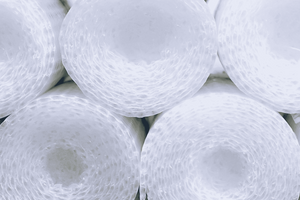
The paper is wound onto the core in compressed form: an almost flat sheet with small die-cut slits. When you stretch it by hand or pull it through a dispenser, the cells open and the paper becomes three-dimensional. That is why calculations should be based on the length of expanded paper, not the roll length.
30, 42 or 50 cm: choosing the roll width
Roll width decides how tall an item you can wrap in one pass while still folding the edges over the ends. A handy rule of thumb:
required width ≈ item height + 2 × fold-over allowance.
The allowance depends on shape: 5–6 cm per side is usually enough for a low mug, while a bottle or a narrow-necked vase needs 8–10 cm. These figures are our working assumption, not a standard. Check them with a test wrap of your own product.
When 30 cm is enough
The 30 cm roll is the most popular format for online shops selling small and medium items: candles, cosmetic jars, mugs, glasses, bottles of perfume, ceramics up to 15–20 cm tall. It is light, takes little space on the bench and gives you no "extra" width to tuck in. To get started, a short 30 cm × 10 m roll is convenient; once your usage is clear, move to 30 cm × 100 m. For a lighter, gift-like look there is a white 30 cm × 50 m roll.
When you need 42 or 50 cm
A wide roll is needed for tall items and large flat ones: wine bottles, vases, large plates, picture frames, mirrors, décor. The 42 cm width is a good compromise for plates and low vases (42 cm × 100 m). The 50 cm width covers bottles, frames up to 30 × 40 cm and long items (50 cm × 10 m for testing, 50 cm × 50 m for daily work).
For bottles there is also a dedicated option: honeycomb paper sleeves, 35 or 45 cm long, that simply slide over the bottle with no unrolling or tearing.
One width or two?
Look at what you shipped last month. If 80–90% of parcels contain small items, keep a 30 cm roll on the bench and order the wide roll only for specific products. With a mixed range it pays to set up two stations or two holders with different rolls. Wrapping a mug in 50 cm paper means constantly trimming and folding excess, which is paying for metres that go straight into the bin.
How to calculate honeycomb paper usage per item
Usage depends on three values: the item's circumference, the number of wraps and the allowance for overlap and ends. The formula for expanded paper:
L (expanded) = circumference × number of wraps + overlap allowance.
To convert this into metres taken from the roll, divide by the expansion ratio: L (from roll) = L (expanded) ÷ 1.68. The number of items per roll is: N = roll length × 1.68 ÷ L (expanded).
Choose the number of wraps by fragility: sturdy ceramics usually need two, thin glass three or more. The honeycomb cells interlock, so the end of the wrap does not need tape, but an overlap of 15–20 cm helps "lock" the wrap.
Worked example for different products
The table below is a worked example based on assumed values: we chose the item sizes, the number of wraps and a 20 cm overlap ourselves to illustrate the method. These are not Viskom figures and not a guaranteed usage. Plug in your own dimensions, or do 3–5 test wraps and measure the actual length.
| Item (assumption) | Roll width | Circumference × wraps | Expanded paper | From roll | Items per roll |
|---|---|---|---|---|---|
| Glass Ø 7 cm, 10 cm tall | 30 cm | 22 cm × 3 | ≈ 0.86 m | ≈ 0.51 m | ≈ 195 per 100 m roll |
| Candle jar Ø 8 cm, 10 cm tall | 30 cm | 25 cm × 3 | ≈ 0.95 m | ≈ 0.57 m | ≈ 176 per 100 m roll |
| Mug Ø 9 cm with handle | 30 cm | 35 cm × 3 | ≈ 1.25 m | ≈ 0.74 m | ≈ 134 per 100 m roll |
| Plate Ø 25 cm | 42 cm | 50 cm × 2 | ≈ 1.20 m | ≈ 0.71 m | ≈ 140 per 100 m roll |
| Bottle Ø 7.5 cm, 30 cm tall | 50 cm | 24 cm × 3 | ≈ 0.91 m | ≈ 0.54 m | ≈ 92 per 50 m roll |
| Frame 30 × 40 cm, 2 cm thick | 50 cm | 64 cm × 2 | ≈ 1.48 m | ≈ 0.88 m | ≈ 56 per 50 m roll |
The key takeaway: small items often take less than a metre from the roll, so a 100 m roll covers far more than "a hundred orders". On the other hand, a set of six glasses under the same assumptions needs about 5.2 m of expanded paper, or roughly 3.1 m from the roll.
From one item to one order to one month
An order rarely contains a single item. To plan purchasing, calculate usage per average order, not per product:
- Take 20–30 typical orders from last week and add up the paper for every item in each.
- Add paper for void fill if you also use honeycomb as a separator between items or as a layer at the bottom of the box.
- Calculate the average — this is your expanded paper per order.
- Multiply by orders per month and divide by 1.68.
- Add a reserve for waste and offcuts — start with 5–10% and refine it from real data.
Example with assumed figures: 40 orders a day, an average of 1.5 m of expanded paper per order, 22 working days. 40 × 1.5 × 22 = 1,320 m of expanded paper. 1,320 ÷ 1.68 ≈ 786 m from the roll. With a 5% reserve that is about 825 m, i.e. nine 100 m rolls a month. Your numbers will differ, but the logic is the same.
These figures feed straight into your unit costs. We explain how to include packaging materials in the cost of each shipment in "How to Calculate the Packaging Cost of One Order".
Short or long rolls?
10 m and 20 m rolls are handy for testing a new product, for small shops and for gift wrapping in coloured paper. 50 m and 100 m rolls suit daily work: fewer roll changes and fewer leftovers on cores. A brown 30 cm × 100 m roll weighs only 2 kg, so even the "big" format is easy to handle on the bench or shelf.
Packing tips that keep usage under control
- Stretch evenly. Under-stretched paper uses less length but cushions poorly; over-stretched paper tears along the slits. Even expansion means both protection and predictable usage.
- Mark standard lengths on the bench. Stick marks on the edge of the table, for example at 0.9 m and 1.3 m, for your most common products. Packers pull to the mark instead of guessing.
- Combine with tissue paper. Viskom product pages note that honeycomb paper can be used together with interleaving paper: a layer of tissue paper under the honeycomb protects glossy surfaces and makes unboxing neater. More on this in "What Tissue Paper Is For and How to Use It".
- Don't try to fill the whole box with it. Honeycomb works best as a wrap and separator. If the box is too large, choose a smaller one or add void fill instead of extra wraps.
- For fragile goods, follow the rule "the item never touches the walls or other items". The full procedure is in "How to Pack Fragile Items: A Step-by-Step Guide".
Do you need a honeycomb paper dispenser?
A dispenser (also called a converter or expander) is a roll holder that feeds the paper under tension. The cells open evenly, and the packer works with both hands on the product instead of fighting the roll. Below is how to decide whether you need one and what to look for.
When you can do without a dispenser
If you pack only a few orders a day, a 10–20 m roll and hand stretching are perfectly adequate. Put the roll in a shallow box or on a simple holder at the edge of the table, pull out the length you need up to the mark, tear along the slit line and stretch.
When a dispenser pays off
- packing has become a daily flow, and you change rolls more than once a week;
- several people work at the bench, and you want the same usage for the same product;
- you see unevenly stretched or torn paper and too many offcuts.
These are guidelines rather than a hard threshold. The simplest check: for one week, record how many rolls you use and compare actual usage with the table calculation. If the gap is large and consistent, a dispenser is worth serious consideration.
What to check before choosing one
- Width compatibility. The dispenser must match your roll width: 30, 42 or 50 cm. If you use two widths, check whether it is adjustable.
- Core and roll diameter. Make sure 50 m and 100 m rolls fit the holder.
- Bench space. A tabletop dispenser should feed paper straight into the working area.
- Tear edge. A convenient tear edge speeds up work and reduces offcuts.
If you are unsure which roll width suits your equipment, contact the Viskom team: they will tell you which lengths are in stock for each width.
Common mistakes when estimating usage
- Ignoring the expansion ratio. 100 m on the core is about 168 m of expanded paper. Without this correction you over-order.
- Using one wide roll for everything. With small items a wide roll produces unnecessary offcuts.
- Forgetting separators between items. In multi-item orders, separators can take a noticeable share of the paper.
- Not testing the calculation. Any table is just a model. Three to five test wraps give a more accurate figure than any general rule.
For more ways to cut costs without putting products at risk, read "How to Save on Packaging Without Compromising Product Quality".
FAQ
How many metres of expanded paper does a 100 m honeycomb roll give?
According to Viskom product pages, the expansion ratio is 1.68, so 100 m on the core gives about 168 m of ready-to-use honeycomb paper.
Which honeycomb paper width is best for mugs and glasses?
For most mugs, glasses, candles and bottles up to 15–20 cm tall, a 30 cm roll is usually enough. Confirm it with a test wrap of your tallest item.
Do you need tape to secure honeycomb paper?
Usually not: the opened cells interlock, so the wrap holds by itself. Tape is only needed to close the box.
Can you use honeycomb paper without a dispenser?
Yes. At low volumes the paper is stretched by hand. A dispenser makes sense once packing becomes a continuous flow and consistent usage per order matters.
Summary
To avoid overpaying for honeycomb paper, choose the width for your typical product (30 cm for small items, 42–50 cm for tall and flat ones), calculate usage with the formula and the 1.68 expansion ratio, and check it with a few test wraps. After that, planning monthly roll purchases becomes simple arithmetic. You can choose rolls of the right width and length in the Viskom honeycomb paper catalogue.