For years bubble wrap was the standard for protecting parcels, and for good reason: the air bubbles absorb shocks well. But it is plastic that takes up a lot of space in the warehouse and usually goes straight into the customer’s bin. More and more stores are looking for a replacement that protects just as well but can be recycled with the box. Here are the paper and biodegradable materials that can replace bubble wrap and what each one is good for.

Wrapping or filling: define the job first
Bubble wrap is used for two different things, and the replacement should be chosen separately for each:
- wrapping: a protective layer directly around the product that absorbs shocks and prevents scratches;
- void fill: material that takes up the empty space in the box so the product does not move or hit the walls.
For wrapping, use bubble paper, honeycomb paper, a paper sleeve, or thin tissue paper for small items. For void fill, use paper fillers and paper air cushions.
Paper materials for wrapping
Bubble Paper
The closest replacement in principle. Bubble Paper combines strong kraft paper with air bubbles, so it behaves like familiar bubble wrap: the outer paper layer protects against punctures and scratches, and the bubbles cushion impacts and vibration. The material is 100% recyclable and works best for small and medium-sized products. Wrap especially fragile items in several layers.
Honeycomb paper
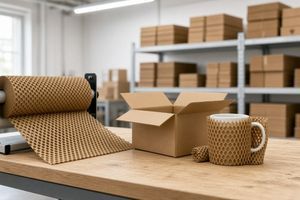
Honeycomb kraft paper has die-cuts that open into a 3D mesh when stretched. The mesh springs back and absorbs shocks, and the cells interlock, so the wrap holds without tape. Bottles, jars and cylindrical products are even quicker to pack in a paper honeycomb sleeve that you simply pull over the item. Packing systems such as WrapPak use a similar principle: perforated paper wraps the item tightly and stabilises it in the box.
Kraft paper and tissue
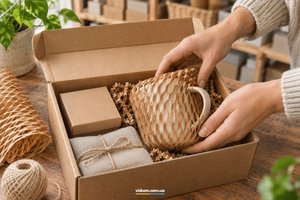
Ordinary kraft paper on a roll (30, 50 and 70 cm wide) can also replace bubble wrap if you pack correctly. A flat layer around the item protects against scratches, and tightly crumpled paper forms a cushion against impacts. You will need more of it than bubble wrap, but it can be recycled almost anywhere. For small delicate items such as porcelain cups or glasses, thin tissue paper works well: it will not scratch the surface, although it is not enough for large and heavy items.
Paper materials for void fill

PaperWave Bio paper air cushions
If you already work with an air cushion machine, you can switch to paper without changing equipment. PaperWave Bio cushions are made of recycled paper with a thin compostable sealing layer. A roll of 3,000 perforated 100 × 210 mm sections is compatible with AirWave 1 and AirWave 2 machines. These cushions are designed for light and very light products: they fill voids, hold the product in place and protect edges. According to the manufacturer, the material can be home-composted or disposed of with organic waste, and it carries the RESY symbol and a DIN 6120 sorting symbol. We wrote about PaperWave winning the World Star Packaging Award in a separate news item.
EcoPack paper void fill
The simplest start for a small store. EcoPack is a roll of paper in a compact dispenser box: you place it on a shelf above, below or next to the packing table, pull out and tear off as much paper as you need and put it in the box. No electricity or training is needed. The paper is made from 100% recycled material and can fill voids around any products, small or large.
WaveFill and SpiralPack
Once fluffed up, WaveFill paper void fill forms voluminous waves of paper that hold the product and look good when unboxed. We showed how to pack with it step by step in the article “How WaveFill paper void fill works”. Another option is SpiralPack spiral paper: you grab it by the “tail”, shake it and the spirals open into a fluffy cushion. Its flat design saves space at the packing station, so it is handy where space is tight.
What to choose for your product
- Cosmetics, candles, tableware, small ceramics: a honeycomb or bubble paper wrap with paper void fill around it.
- Bottles and jars: a honeycomb sleeve or several layers of bubble paper, plus void fill so the bottle does not touch the walls.
- Light products in a large box: PaperWave Bio paper air cushions or EcoPack.
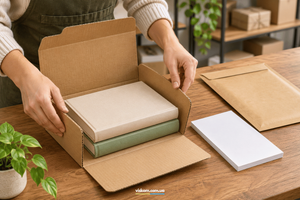
- Clothing and textiles: bubble wrap is usually not needed at all; tissue or kraft paper is enough.
- Heavy and very fragile products: here bubble wrap remains a reliable choice for now, and that is fine. We explained how to use it properly in the article “What is bubble wrap for”.
Polystyrene “peanuts”, also used for void fill, are not an eco-friendly alternative: they are the same plastic, and they spill all over the box as well.
Replacing bubble wrap with paper does not mean giving up protection. The right paper material holds the product just as well, and the customer will not have to wonder what to do with the plastic after unboxing. If you are torn between bubble wrap and air cushions, see our comparison “Bubble wrap vs AirWave”.