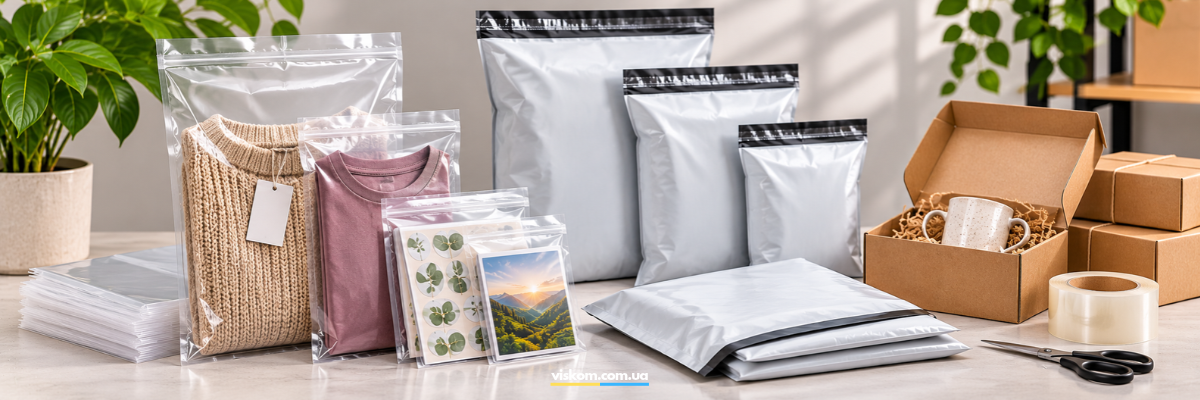
When an online shop is just starting out, packaging tends to be bought "just in case": a few bags of one size, a few of another, one more because it happened to be in stock. A few months later the storeroom holds ten different packs, half of them opened once or twice, and the size you need right now is missing. It is far easier to put together a short working kit once: a few sizes of clear BOPP bags for the product itself and a few sizes of courier mailer bags for shipping. Below we walk through how to choose those sizes for your range, how they pair up and how many to keep in stock.
Why fewer sizes work better
Every extra size means another shelf, another line in your stock records and another decision the packer has to make for every order. The more options there are, the more often a product ends up in a bag that is too big and slides around, or too tight, so the film is stretched over the corners. And you collect leftovers that nobody touches for years.
Most small online shops get by with two or three BOPP sizes and two or three mailer sizes. Viskom's range gives you plenty to choose from: BOPP bags with an adhesive flap from 60×90 to 500×600 mm, and courier mailers from 130×190+40 mm (A6) to 660×500+40 mm. The goal is not to cover the whole range, but to pick the handful of sizes that fit your actual orders.
Two layers, two different jobs
Before you start counting sizes, separate the roles of the two bags. They are often confused.
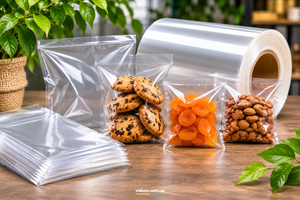
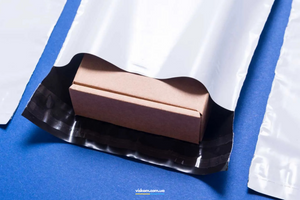
- The BOPP bag is product packaging. It is made of biaxially oriented polypropylene, 25 µm thick. The film is clear, slightly glossy and does not absorb water. At the top there is a 40 mm adhesive flap that seals without tape and survives several openings if you need to check the contents. The customer sees the product before opening it, and in the storeroom the bag keeps dust off.
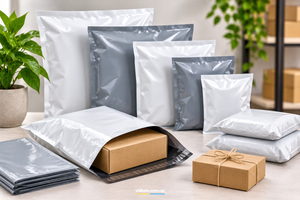
- The courier mailer is the outer shipping layer. It is made of multilayer polyethylene, 50–60 µm thick depending on size, with a self-adhesive flap. The flap is usually single-use: once opened, the mailer is not sent again.
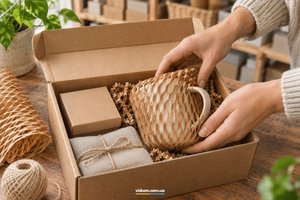
Neither bag absorbs impacts or holds its shape under pressure. So the "BOPP inside, mailer outside" setup suits soft, non-fragile goods: textiles, accessories, printed matter and items that already have their own small box. Glass, ceramics and electronics go into a carton with void fill, where a bag is only an extra layer against dust. We cover each bag type in more detail in "BOPP bags: what they are and how to choose" and "Courier bags: how to choose a size and how to pack them".
Step 1. Look at what you actually ship
Take your last 50–100 orders. If the shop is brand new, use your product list and the most likely bundles. Sort them into groups by size, in the form in which they travel to the customer:
- small items that fit in the palm of your hand;
- flat items up to roughly A5;
- folded textiles and A4 prints;
- large soft items;
- long, narrow items, if you sell any.
You will usually see straight away that 80–90% of orders fall into two or three groups. Those groups define your core kit. Rare sizes are better covered by one "spare" format than by a separate bag for every product.
Step 2. Measure the packed item, not the product listing
The size on the product page tells you little about how the item will sit in the bag. A T-shirt gets folded, earrings go on a backing card, a greeting card travels with an insert, cosmetics stay in their branded box. Measure exactly that: the width, height and thickness of the finished item.
Then apply a simple rule: add the item's thickness plus another 10–15 mm to its width and height. The film should not be stretched over corners and seams, and there must be room above the product to close the flap neatly. Depending on the model, BOPP bag sizes may be given with or without the flap, so check the description of the specific product before you order. For mailers, 240×320+40 mm means width, height of the main body and flap length. The flap adds no usable height: the item has to fit within 240×320 mm.
Step 3. Pair a BOPP bag with a mailer
When the product travels in a BOPP bag, you choose the mailer for the BOPP bag, not for the product itself. The inner bag should slide into the outer one freely, with room for thickness and no creases along the flap line. Here are pairs from the Viskom range that work well together. Item sizes in the table are approximate and assume flat items; bulkier goods need more clearance.
| What you pack | Packed item, approx. | BOPP bag | Courier mailer |
|---|---|---|---|
| Jewellery on cards, pins, small hardware | up to 50×80 mm | 70×100 mm | 130×190+40 mm (A6), several BOPP bags fit in one |
| Greeting cards, accessories, small sets | up to 130×180 mm | 150×200 mm | 190×240+40 mm (A5) |
| Long, narrow items | up to 120×280 mm | 140×300 mm | 250×360+40 mm |
| Folded textiles, A4 prints | up to 230×320 mm | 250×350 mm | 300×400+40 mm |
| Large soft items | up to 380×520 mm | 400×550 mm | 660×500+40 mm, BOPP bag laid sideways |
The last row shows a handy trick: you can turn the bag. A 400×550 mm BOPP bag will not go into a 400×600+40 mm mailer, because the widths are identical and there is no clearance. In a 660×500+40 mm mailer it lies with its long side along the width, leaving about 100 mm of clearance both across and lengthwise. So when matching pairs, check both orientations.
Before ordering a batch, do a few test packs with your best-selling products. You will see at once whether the bag is too tight or too loose.
Step 4. Build your working kit
Now pick the table rows that match your product groups. A few examples:
Jewellery and handmade small items
BOPP 70×100 and 150×200 mm, mailers A6 and A5. Four items cover almost everything: a single piece goes in A6, a set with a card or several pairs of earrings in A5.
Clothing and textiles
BOPP 250×350 and 400×550 mm, mailers 300×400+40 and 660×500+40 mm. If you often ship a single T-shirt or underwear, add a smaller size such as 190×240+40 mm (A5). We explain how to fold garments neatly in "How to pack clothes for posting".
Printed products
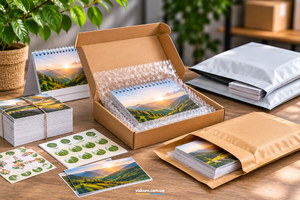
BOPP 150×200 and 250×350 mm, mailers A5 and A4. For cards, calendars and prints that must not bend, add a rigid stiffener. A size table for print formats is in "How to mail postcards, calendars and stickers".
If you sell a mixed range, start with your three most popular pairs and add the rest once you see real demand.
Pocket, handle, colour: when you really need them
Mailers come in variants that are tempting to buy "just in case". It is better to buy them for a specific job.
- Document pocket. A clear pocket is useful when paperwork has to travel on the outside: a delivery note for a wholesale customer, an invoice. In the Viskom range a pocket is available in sizes including 190×240, 240×320, 250×360, 300×400, 380×400 and 430×500 mm, for example the 240×320+40 mm (A4) mailer with pocket. If the receipt goes inside and the label is stuck directly on the bag, you do not need one.
- Handle. Handle versions exist in the large sizes 300×400, 380×400, 400×600 and 500×500 mm, for example the 300×400+40 mm mailer with handle. They make sense when you hand orders over in person, say at a pick-up point or a market stall.
- Colour. Besides white, the range includes grey, yellow, light blue, orange, pink and green mailers, including the 300×400+40 mm size. Colour is handy for sorting: one colour for exchanges, another for gift orders or wholesale shipments. Keep in mind that colour alone does not guarantee opacity, so check the specific model if the contents must not show through.
How many bags to keep in stock
Working out stock levels is simpler than it looks. A BOPP bag is usually used once per item or set, a mailer once per order. So count separately: how many units you ship per week on average and how many orders.
Then, for each size: weekly usage × weeks until the next delivery + a buffer for peaks. If you ship 150 orders a week in A5 mailers and restock every two weeks, you need at least 300 mailers plus a reserve for sales. At Viskom, BOPP bags come in packs of 100 and 1,000, mailers in packs of 100. So it makes sense to buy your best-selling BOPP size in packs of 1,000 and rarely used sizes in packs of 100.
Some items in the catalogue are marked "made to order", so agree lead times with a manager in advance rather than when the last pack runs out. Before seasonal peaks, check your stock against our Black Friday packing checklist.
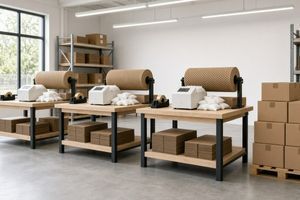
How to set up the packing station
- Keep fast movers within reach. Keep the two or three most popular sizes on the table and the rest on a shelf nearby.
- Label the shelves. A simple code such as "B 150×200" and "M A5" saves seconds on every order and cuts mistakes when someone new is packing.
- Keep packs closed. The flap adhesive holds well when the bonding area is clean. Dust and lint from an open pack end up on the adhesive and weaken the seal.
- Store pairs side by side. Put each BOPP size next to its matching mailer, so the packer grabs both in one move and never has to think about what goes with what.
Common mistakes
- Buying "one pack of every size". Most of those packs stay half-used, and the size you need is still missing.
- Measuring the product without its extras. A backing card, an insert, a branded box or tissue paper all add width and thickness.
- Counting the flap as height. 240×320+40 gives 320 mm of usable height, not 360.
- Choosing an oversized mailer. The product moves around, the corners of the BOPP bag get crumpled and the parcel looks sloppy. One size smaller, checked with a test pack, is usually better.
- Shipping in a BOPP bag alone. It is product packaging, not a shipping bag: thin clear film is not designed for sorting centres and transport.
FAQ
How many bag sizes do I need to start with?
For most small shops, two or three BOPP sizes and two or three mailer sizes. Add new formats when you see that certain orders regularly do not fit the ones you have.
Can I put several BOPP bags into one mailer?
Yes, as long as they lie flat, do not stretch the film and leave room for the flap. For example, several 70×100 mm bags fit easily into an A6 mailer of 130×190+40 mm.
Do I have to use a BOPP bag if the product already ships in a mailer?
No. A BOPP bag is worth it when the product should be visible without opening, needs protection from dust in storage, or when several items have to be grouped as a set. Otherwise one mailer is enough.
How can I tell that a mailer is too big?
If, after sealing, the product slides freely from edge to edge and the bag folds up like an accordion, go one size down. A well-chosen mailer hugs the contents without stretching at the corners.