A small shop often keeps a single “spare” roll: someone picked it up because it was to hand, and a week later the paper is too narrow for the box or runs out halfway through a shift. Kraft paper on a roll covers a lot of jobs — from a gift wrap to everyday dispatch — but only if the width, length and colour match the orders you actually pack. Below we stick to what is in the Viskom catalogue and explain how to put together a working set without leftover rolls you never finish.
How wrapping kraft differs from honeycomb paper and tissue
The kraft paper for packing section brings together several different materials, and they are easy to mix up. Wrapping kraft on a roll is a smooth sheet you wrap around a product or a box. On the plain 30 cm rolls we checked, the substance is 70 g/m²: the paper holds its shape, cuts and folds easily, but it hardly cushions a knock on its own.
If the item is fragile, it needs protection first. That is what Honeycomb kraft paper is for — you stretch it and the sheet turns into a springy mesh around the goods. We have already described how it works in “Honeycomb paper”. Another paper option with air cells is Bubble Paper. And to make the contents look neat and to stop them scuffing from the inside, you add tissue paper on top or underneath. Its role in unboxing is covered in “What tissue paper is for”.
In short: the wrapping roll is the outer layer and the look of the parcel. Honeycomb, Bubble Paper or tissue do different jobs, and they belong beside the roll, not instead of it.
How to choose the roll width
The wrapping-kraft catalogue lists rolls 30, 50 and 70 cm wide. Width is the main setting: it decides whether the sheet will cover a box or a gift in one turn, with enough left to fold under.
- 30 cm is the most versatile width for smaller orders: cosmetics, books, candles, folded textiles, mid-size gifts. A compact 30 cm × 12 m brown roll is a handy way to test whether this width is enough, without taking up much of the bench.
- 50 cm suits larger boxes, clothing and multi-item sets, when 30 cm has to be joined with an overlap and the seam sits across the lid. Rolls of this width are in the section; check current availability before you order.
- 70 cm is a wide sheet for large boxes, flowers and gift wrapping. This is also the format of the printed kraft paper in the catalogue: every ready-made pattern comes as a 70 cm × 7 m roll.
A practical test: put a typical box or item on the table and measure how much paper you need to wrap it with a 3–5 cm overlap and still fold the ends. If 30 cm covers most of your orders, do not jump straight to the widest roll “just in case” — it is awkward on small items and uses more paper.
Which length to take: 7, 12, 20, 50 or 100 metres
Roll lengths in the catalogue are 7, 12, 20, 50 or 100 metres. The minimum order on the items we checked is one roll, so you can start short and skip a warehouse-size stock.
- 7–12 m is a short roll for a small shop, seasonal wrapping, or simply to try a width and colour. Seven metres is the standard length of the printed paper; 12 metres is a comfortable start for a plain 30 cm roll, such as the white kraft 30 cm × 12 m.
- 20 m is the middle option, when the colour or format is already proven and you pack regularly, but not yet dozens of parcels a day. The pink kraft 30 cm × 20 m comes in this length, for example.
- 50 and 100 m belong on a packing bench with a steady flow of orders. One 30 cm × 50 m roll needs changing mid-shift less often than four short 12 m rolls.
A longer roll saves time at the bench: fewer changeovers and fewer offcuts at the join. A shorter one is better if you wrap only now and then, or if you are testing a new colour.
Table: which roll for which job
| Roll | Substance | Best for |
|---|---|---|
| 30 cm × 12 m, brown | 70 g/m² | Small gifts and goods, a first try of the width |
| 30 cm × 12 m, white or 30 cm × 50 m, white | 70 g/m² | Light packaging, overprinting, cosmetics, a neutral background |
| 30 cm × 20 m, pink or 30 cm × 50 m, pink | 70 g/m² | Gift and festive dispatches |
| 50 cm (20, 50 or 100 m) and 70 cm × 7 m, plain | see the product card | Larger boxes and sets; check availability in the catalogue |
| 70 cm × 7 m, printed (Newspaper, Letters, Design, Polka Dot) | 60 g/m² | Gift wrap, flowers, a branded look without a second wrapper |
70 g/m² on the plain 30 cm rolls is a mid-weight wrapping kraft: stronger than tissue, thinner than board. The printed paper is listed at 60 g/m²: the sheet is a little lighter, but wider, and it is meant as gift wrap. The section text also mentions other substance ranges, so for any less usual item always read the figure on the product card.
Colour: brown, white, pink and the rest of the range
Classic brown kraft looks natural and pairs well with paper kraft tape: the parcel stays in one material, without a clear plastic strip on top of the paper. How to apply water-activated tape is in the article “Water-activated kraft tape: what it is and how to use it”.
White kraft gives a cleaner, shop-like look and is a better base if you will add a sticker or print — type reads more clearly on a white ground. Pink suits gifts and seasonal orders, when you want the wrap to stand out from an ordinary box already at the post office.
The wrapping-roll section also lists red and black paper in the same 30 cm width. The colours on offer depend on stock, so choose the colour from the live row in the catalogue, not “for later”.
When to choose printed kraft paper
If a plain roll is the product’s working “shirt”, printed paper sets the unboxing mood at once. At Viskom these are ready-made designs in one format: 70 cm × 7 m, 60 g/m². On a brown ground the print is black or white; on white it is black. The patterns include “Newspaper”, “Letters 01”, “Letters 02”, “Design 01”, “Design 02” with a white print, and “Polka Dot Black” (there is a white polka-dot version too).
This roll makes sense when the wrap is part of the impression: candles, cosmetics, handmade goods, flowers, gift sets. For ordinary daily parcels, where the paper only covers a box before the tape, it is calmer to work with a plain 30 cm roll and add mood with tissue or a sticker.
The 70 cm width is convenient for a gift or a large box. If most orders are small, you will have to slit the wide sheet lengthways — that is possible, but on a busy bench it is easier to keep a separate narrow plain roll.
How to wrap so the paper does not tear and still looks tidy
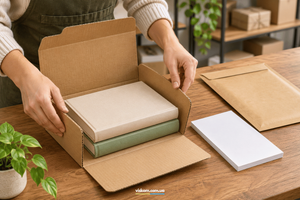
- Place the item, or an already closed box, on the paper. Pull enough sheet to go around with a 3–5 cm overlap. The ends should leave enough to fold like a gift — about two thirds of the box height on each side, no more, or you will get bulky “ears”.
- Cut the paper straight. Kraft of 70 and 60 g/m² cuts cleanly with scissors or a knife against a rule; tearing by hand leaves a fibrous edge.
- Fix the long overlap first, then fold the ends like an envelope and fasten them. It looks cleanest with paper kraft tape in the same colour as the wrap. Clear plastic tape shows at once on brown paper.
- If the goods are fragile, wrap them in honeycomb or Bubble Paper first, and only then in plain kraft. The wrapping roll is not a cushion.
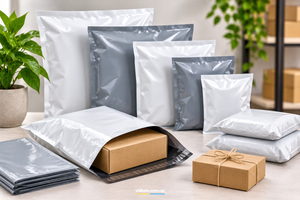
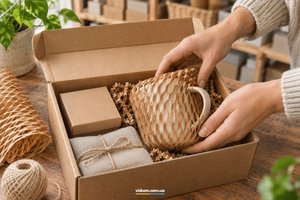
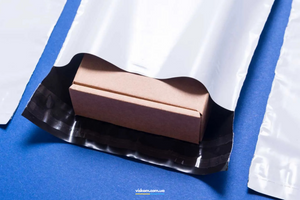
- For a nicer unboxing you can add tissue inside. If the wrapped item is going without a box, put it in a courier bag. Kraft itself is not built for a postal sort line: rain, a belt and neighbouring parcels will crease or tear it.
Typical mistakes
- Buying one wide roll “for everything”. 70 cm is awkward on small orders, and 30 cm will not cover a large box without a seam. Two working widths beat one “universal” roll that nobody likes using.
- Stocking many short rolls instead of one long one. If 30 cm kraft is used every day, one 50 m roll on the bench is easier than four 12 m rolls.
- Expecting thin kraft to protect glass or ceramics. 60–70 g/m² is a wrap, not a shock absorber. Fragile goods need honeycomb or another filler first; we collected paper alternatives to bubble wrap in “What to use instead of bubble wrap”.
- Sealing the paper with clear tape. It holds, but it looks accidental. Paper tape closes the seam in the same material and is easier to recycle with the wrap. Why a paper-only pack can be worth it is in “What ecological packaging actually means”.
Frequently asked questions
What width is enough to start with?
For most small online shops a 30 cm roll is enough — the brown or white 30 cm × 12 m, for example. If your usual boxes are wider and the overlap will not meet, add 50 or 70 cm and keep the narrow roll for small orders.
What is the difference between 70 g/m² and 60 g/m²?
The plain 30 cm rolls are listed at 70 g/m²; the printed 70 cm × 7 m paper is listed at 60 g/m². The gap is small: the printed sheet is a little lighter and drapes a bit more softly, the plain 70 g/m² is a little denser. Both cut and fold by hand; for a heavy or sharp item that is still not enough without inner protection.
Can kraft paper replace a box or a courier bag?
Not if the parcel is going by post or a delivery service. The wrap keeps up appearances and keeps dust off, but not moisture or knocks on the sort line. Put the wrapped item in a box or a courier bag.
How many rolls should we keep in stock?
Start with one short roll in your working width and colour and see how many days it lasts. If 12 metres disappear in a week, take 50 m of the same format next. Keep a separate short printed roll only when you really have many gift orders — otherwise it will sit half-used for a long time.
Do we need both a plain roll and printed paper?
Not necessarily. If most dispatches are routine, plain kraft and, if you like, tissue will do. Printed paper is for when the wrap should look like a gift. Two rolls are justified when those flows are genuinely separate, not “just in case”.