Returns are a normal part of online retail. Customers have the right to send goods back, and the store has to accept them without losing money, time or the customer. Most problems are caused not by the return itself but by the packaging: the customer tears the box open, has nothing suitable to repack the item in, seals it with household tape or drops it into a plastic bag, and the parcel arrives at the warehouse damaged. In this article we look at how return boxes with a dual adhesive strip (on the market you will find names such as Sendbackbox or Packfix Return) simplify reverse logistics and where exactly they help you save money.
The guide is useful for online stores selling clothing, footwear, cosmetics, electronics, books and accessories, in other words for anyone with a noticeable return rate, where every returned parcel takes up warehouse and customer service time.
Why returns cost more than you think
When a store calculates the cost of returns, it usually sees only the return shipping fee. In reality there are many more cost items, and some of them are hidden:
- Packaging for the return shipment. If the customer has nothing to pack the item in, they buy a box at the carrier's branch or use whatever they have at home. This decides the condition in which the item comes back.
- Damage during the return. An item in a torn or ill-fitting box is more likely to be crushed, scratched or soiled. Such goods are hard to resell at full price.
- Warehouse time. The parcel has to be received, opened, checked for completeness and condition, then restocked or sent to clearance. The more chaotic incoming returns are, the longer each step takes.
- Customer service workload. Questions like "how do I pack it", "can I use a bag", "where do I get a box" keep your team busy, and disputes over damaged goods take even longer.
- Customer loyalty. A complicated return discourages the next purchase. A simple, clear return process builds trust in the store.
Most of these costs can be reduced at the first shipment, simply by packing the order in a box that is ready to be used for a return.
What is a box with a dual adhesive strip?
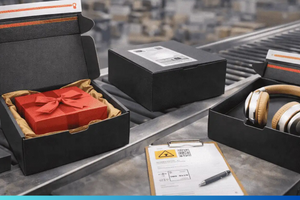
A return box is a corrugated mailer box with two adhesive strips under release liners on the closing flap. The store uses the first strip when packing the order. The second one is left for the customer: if the item does not suit them, they put it back, peel the liner off the second strip and seal the box without any tape. For neat opening, such boxes usually have a tear strip, so no scissors or knife are needed and the box itself stays intact.
How it works in practice: three steps
- Shipping. The packer puts the item in the box, peels the liner off the first adhesive strip and closes the flap. No tape is required.
- Delivery. The customer opens the box using the tear strip. The box stays intact and the second adhesive strip is still covered by its liner.
- Return. If the item has to go back, the customer places it in the same box, peels the liner off the second strip, seals the flap and attaches the return label.
The idea is simple: one box travels to the customer and back, and the customer does not need to find or buy anything.
Standard box with tape vs return box
To see where the savings come from, let us compare two scenarios.
| Stage | Standard box + tape | Box with dual adhesive strip |
|---|---|---|
| Sealing in the warehouse | Tape and a dispenser needed, several strips per box | Peel the liner, close the flap with the adhesive strip |
| Opening by the customer | With a knife or scissors, the box often tears | With the tear strip, the box stays intact |
| Packaging for the return | Customer finds a box and tape on their own | Same box, the second adhesive strip is already there |
| Condition of the returned item | Depends on what the customer found | Item comes back in a box of the right size |
| Inspection in the warehouse | Traces of different tapes, hard to judge tampering | Standard box, easier to check integrity |
Where the savings come from: cost by cost
Fewer consumables in the warehouse
A box with an adhesive strip does not need tape to close. If the box also has an automatic bottom, like Smart Box cartons, the packer does not reach for the dispenser at all: open the box, insert the item, close the flap. At high volumes this saves both tape and time.
Faster packing
A box with an automatic bottom is erected in one move, and closing it with the adhesive strip takes seconds. This cuts the time per order and takes pressure off packing stations on peak days.
Fewer damaged returns
The item comes back in the same box that was chosen for its size. If the shipment contained void fill, the customer can reuse it. As a result, more returned goods can go straight back to the shelf instead of clearance.
Faster processing in the warehouse
When returns arrive in standard boxes, the warehouse follows one routine: check integrity, open, inspect the item, update the stock records. Nobody has to deal with bags, plastic-wrapped bundles or other people's boxes of the wrong size.
How to estimate the effect for your store
The most honest way to assess the benefit is to use your own figures. Take your current packaging cost per order (box, tape, void fill, packer's time) and compare it with a box that closes without tape. Separately, estimate how many returns per month arrive damaged because of unsuitable packaging and what each such case costs. We explained the calculation method in detail in "How to Calculate the Packaging Cost of One Order".
Which boxes are available from Viskom
The cardboard boxes section of the catalogue contains self-erecting, self-adhesive e-commerce boxes. The catalogue also has dedicated sections for return packaging: Sendbackbox boxes and Packfix Return. Please check current availability of models and sizes in these sections with a Viskom manager before ordering.
Smart Box cartons
Smart Box cartons use a Peel and Seal closure: an adhesive strip inside lets you close the box without tape, and a tear strip lets the customer open it without scissors. The bottom folds automatically. According to the product pages, the boxes are made of 3-ply TK-22 board, E flute, and come in packs of 20. Sizes in the catalogue: 112×112×360, 170×120×100, 240×170×100, 208×118×357, 317×224×106 and 335×133×377 mm. The category page also points out that an undamaged tear strip shows nobody but the sender has touched the goods.
Book-mailer Box
The Book-mailer Box measuring 307×250×90 mm is designed for books, discs, catalogues, gifts and other flat items. It has a self-adhesive closure and a tear strip, and the height of the pack adjusts to the contents. It is a handy option if you sell flat products and want to ship without tape.
Please note: the product descriptions of Smart Box and Book-mailer Box on the website mention one adhesive strip for closing. If you specifically need a second strip for returns, ask a manager which models are in stock, or include a few strips of self-adhesive kraft paper tape in the parcel together with instructions.
How to choose the right return box size
A return box should fit just as well as a regular shipping box: the item must not move around, but it should not bulge the walls either. A few practical rules:
- Choose box sizes for your best-selling products, not for your largest ones. Keep a separate size for bulky items.
- Leave room for void fill if the item is fragile. The customer can put the same fill back in.
- Check that the box fits within your carrier's dimension brackets so that return shipping does not cost more than necessary.
How to calculate the optimal size and avoid paying for empty volume is explained in "Corrugated Boxes for E-commerce: How to Calculate the Size and Save on Shipping".
Void fill that can be reused
For returns, choose void fill that the customer can easily put back: paper, honeycomb kraft paper or other options from the box fillers section. A comparison of different ways to fill empty space is available in "How to Fill Empty Space in Boxes".
Preventing item swaps in returns
Returns are an attractive moment for fraud: instead of the original item, the box contains a counterfeit, a worn product or a completely unrelated object. Packaging will not solve the problem entirely, but it makes tampering in transit much harder and helps in a dispute.
- Tear strip as an indicator. An intact tear strip on the outbound shipment shows that the box was not opened before it reached the customer.
- Tamper-evident tape for valuable goods. Anti-tamper kraft tape leaves visible marks when someone tries to peel it off, so any opening is obvious.
- Photo and video records. Film the packing of expensive orders and the opening of returns in the warehouse. This is your strongest argument in disputed cases.
More ways to protect a parcel are covered in "How to Stop Package Tampering".
Returns processing in the warehouse: a short checklist
Even the best box will not save money if returns are handled chaotically. Set up a dedicated area and a few simple rules:
- Set aside a returns bench separate from the shipping area, so returned goods do not mix with new stock.
- Before opening, check the integrity of the box and the adhesive strip and photograph the parcel.
- Open the box, compare the contents with the order and assess the condition of the item.
- Sort the goods: back to the shelf, to clearance, write-off or return to the supplier.
- If the box is intact, reuse it for internal transfers or storage.
- Record the reasons for returns. If an item often arrives damaged, change its packaging for the outbound shipment.
This matters most after big sales, when the wave of returns arrives a few weeks after the peak. To prepare for the peak itself, read our "Black Friday Packaging Checklist for Online Stores".
Instructions for the customer: make returns easy
A box with a second adhesive strip only works if the customer knows what to do with it. Add a short instruction to the parcel or stick it on the inside of the flap. Self-adhesive labels with printing work well for this. The instruction should explain:
- that the box should be opened with the tear strip, not cut;
- that the second adhesive strip is meant for the return and its liner is removed only before sending the item back;
- what to put in the box along with the item (return form, receipt, all parts);
- how to create a return label with your carrier.
The fewer questions the customer has, the fewer support requests you receive and the sooner the money tied up in returns is released.
Frequently asked questions
Can a return be sent without tape?
Yes, if the box has a second adhesive strip. The customer peels off the liner and seals the flap, no extra tape is needed.
Are return boxes suitable for heavy items?
Consider the box material and the weight of the item. For heavy shipments, additionally seal the seams with water-activated kraft tape and check the box specifications with a manager.
Can these boxes be branded?
The corrugated surface can take printing or stickers. The simplest option is branded labels or custom printed tape.
Are return boxes worth it if you have few returns?
Even with a low return rate, these boxes save tape and packing time on the outbound shipment. Still, assess the benefit using your own figures and a packaging cost calculation.
Conclusion
A box with a dual adhesive strip solves several tasks at once: tape-free packing in the warehouse, neat opening for the customer and ready-made packaging for the return. The store gets fewer damaged returns, a simpler warehouse process and happier customers. Start with one or two sizes for your best-selling products, add instructions for the customer and measure the effect after a month. If you need help choosing boxes, void fill or tape, contact the Viskom team.