“Eco”, “green”, “natural”: these words appear on almost every package today. Customers increasingly ask what their order will arrive in, and businesses look for materials they do not have to be ashamed of. But what actually makes packaging sustainable? Spoiler: it is not only paper instead of plastic. It matters just as much that the product arrives intact. Here is how to assess packaging materials honestly and without greenwashing.

There is no single definition of “eco-friendly”
In short, eco-friendly packaging is packaging that does as little harm to the environment as possible. The problem is that there is no general legal definition of which packaging counts as eco-friendly and which does not. Different organisations and regulators set their own criteria and minimum standards, and they do not always agree. So an “eco” label guarantees nothing on its own: each time it is worth checking what exactly stands behind the claim. Rules are gradually appearing: we covered how the new EU packaging requirements will affect Ukrainian exporters in the article “PPWR: new EU packaging rules”.
How to assess a material: four questions
1. What is it made of?
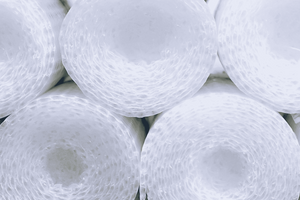
Start with the raw materials. Most materials consist of several components, so look for those with the highest share of renewable, recycled or biodegradable content. For example, water-activated kraft tape is made of paper and a starch-based adhesive, and WaveFill paper void fill is 100% cellulose.
2. How was it produced?
It is not only the raw material that counts but also how much water and energy went into production and whether the process pollutes. This data is not always easy to find, but an honest manufacturer is usually willing to share it.
3. What happens to it after unboxing?
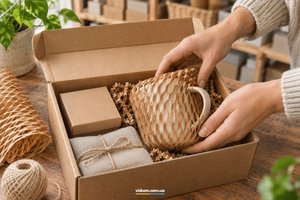
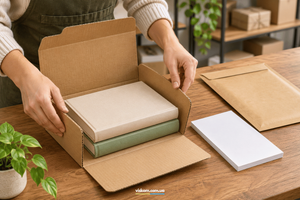
Ideal packaging is either reused, easily recycled or biodegrades. Paper and cardboard are accepted for recycling almost everywhere. That is why a box sealed with paper tape and filled with paper void fill can be recycled as it is, and the customer does not have to sort anything. We showed how cardboard gets a second life right in the warehouse in the article about CushionPack shredders.
4. Can it be used again?
Reusable options usually need a slightly bigger investment but pay off where packaging comes back: with regular partners, or in zero-waste shops where customers buy a container once and then simply refill it.
A damaged product is the biggest environmental loss

This is talked about less often than plastic, which is a pity. The total environmental impact of every online order is made up of many parts: making the product itself, its primary packaging, storage and delivery. Take a tablet as an example. The journey from the warehouse to the customer accounts for only about 2% of the tablet’s total footprint, and the packaging materials make up roughly 15% of those 2%. In other words, packaging is a fraction of a percent of the total impact.
It might seem there is nothing to improve here. But if the tablet breaks in transit because of unsuitable packaging, its environmental impact doubles: another one has to be made, packed and delivered, and the broken one becomes waste. That is why preventing damage is often the most sustainable thing a seller can do.
Many companies consider “small” losses of 1–3% of shipments acceptable. But for a manufacturer selling millions of devices a year, even 1% means hundreds of thousands of broken products, a doubled footprint for each of them and just as many disappointed customers. The most sustainable packaging is the one after which the product never has to be shipped a second time. We described how to choose protection for different types of fragile goods in our step-by-step guide.
Protection and sustainability can go together
You do not have to choose between “safe” and “sustainable”. Here are a few materials that deliver both:
- Honeycomb kraft paper: stretches into a 3D mesh that absorbs shocks and holds on the item without tape. Biodegradable and suitable for food contact.
- Bubble Paper: kraft paper with air bubbles, a paper replacement for bubble wrap when wrapping items.
- WaveFill: paper void fill that fills the gaps in a box and keeps the product from moving.
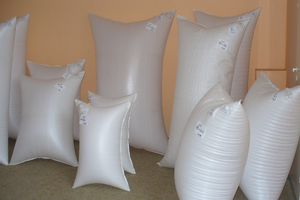
- AirWave air cushions: when you cannot give up film completely, cushions provide a large volume of fill from a small amount of material. Before inflation the film takes up little space, so there is much less of it in storage and in transport than ready-made bubble wrap.
- Water-activated kraft tape: holds the seam more firmly than plastic tape and is recycled together with the box.
Talk about sustainability honestly

Switching to eco-friendly materials is not always easy, especially for a small business. That is why it is important to do it sincerely. If a company deliberately presents itself as greener than it really is, that is greenwashing, and once customers notice, trust is very easy to lose.
Transparency works much better: state plainly what your packaging is made of and how to dispose of it, do not promise “100% eco” where there is plastic, and explain why you sometimes choose stronger protection. Customers have little time to research every purchase, so clear labelling and a short note in the parcel do more than big words. Read more about materials for such solutions in the articles “Eco-friendly packaging materials for responsible business” and “Eco packaging: what are its benefits”.
So eco-friendly packaging is not just “paper instead of plastic”. It is about the right materials, nothing superfluous and, above all, a product that arrives intact the first time.