A greeting card that arrives bent is no longer a gift; it is a reason for a bad review. Printed products do not shatter, but they crease easily, soak up moisture and scuff against each other. The simplest reliable setup for postcards, photo prints, stickers and calendars looks like this: each item or set goes into a clear BOPP bag, a stiff piece of cardboard goes next to it, and the whole thing ships in a courier mailer bag of the right size. Below we cover how to match the sizes of the two bags, what to do with wall calendars, and when you really do need a box.
Why cards, prints and calendars get damaged in transit
At a sorting hub a parcel is tossed into a sack, pressed under heavier boxes, and sometimes left on a doorstep in the rain. With proper void fill a mug survives all that. For a sheet of paper, any one of those moments can be the end.
- Creasing. A soft mailer takes the shape of whatever presses on it. If there is only paper inside, a crease in the card or calendar is almost certain.
- Corners. Even without a fold, corners curl and delaminate, especially on heavy laminated card stock.
- Moisture. Paper absorbs water, cockles and never quite flattens again. A few minutes in the rain is enough if the packaging lets water in.
- Scuffing. When several cards or photos travel loose, gloss finishes and dark backgrounds rub against each other.
Good packaging deals with all four risks, and it does not have to be a box. Print needs rigidity and protection from water far more than cushioning.
The three-layer method: BOPP bag, board, mailer
Layer one is the BOPP bag. The film is biaxially oriented polypropylene: clear, slightly glossy and it does not absorb water. Viskom bags use 25 µm film and have a 40 mm adhesive flap on top. You peel off the release strip, fold the flap over and the bag is closed without tape. The flap can be opened and closed a few times, so you can check a set before it ships without tearing the bag. The customer sees the card or calendar before opening anything, and it looks like retail stock rather than a sheet fresh off a printer.
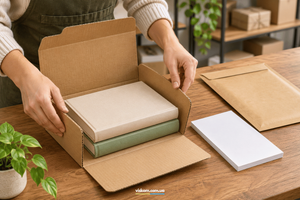
Layer two is the stiffener. A piece of rigid cardboard slightly larger than the item. This is what keeps the shape when the parcel is squeezed. Neither a BOPP bag nor a mailer prevents bending on its own, and that is worth remembering for good.
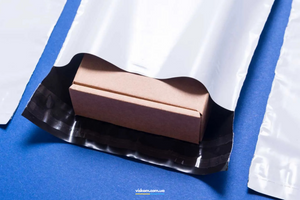
Layer three is the courier mailer. This is the outer shipping pack. Viskom courier bags are made of multilayer polyethylene, 50–60 µm thick depending on size. The shipping label goes on the outside, and the version with a pocket lets you add an invoice or packing slip separately from the goods. A mailer keeps out dust and incidental moisture but does not absorb impact. For print that is fine: it needs a flat support, not a cushion.
We cover each material in more detail in “BOPP bags: what they are and how to choose” and “Courier bags: how to choose the size and how to pack”. Here we focus on combining them for specific printed products.
How to match a BOPP bag with a courier mailer
The rule is simple: choose the BOPP bag for the item, and the mailer for the bagged item plus its board. The first mistake is going by the format name. The 130×190+40 mm courier bag is labelled “A6”, and an A6 card (105×148 mm) does fit inside. But once that card is in a 150×200 mm BOPP bag, a 150 mm width will not go into 130 mm. So the outer bag needs to be one step up.
The second mistake is choosing a bag with no clearance. An A4 sheet is 210×297 mm, and a 220×300 mm bag looks perfect on paper. In practice 3 mm of headroom is not enough: the film pulls tight, corners catch on the way in and the flap closes with a bulge. Leave at least a few millimetres on every side between the item and the seams, and do not count the 40 mm flap as usable height.
Here is a guide for common formats. Bag sizes come from the Viskom range; before a large run, always test-pack two or three pieces.
| What you ship | Item size | BOPP bag | Courier mailer |
|---|---|---|---|
| A6 card, 10×15 cm (4×6 in) photo | 105×148 mm, about 100×150 mm | 150×200 mm | 190×240+40 mm (A5) |
| A5 card or art print | 148×210 mm | 200×250 mm | 240×320+40 mm (A4) |
| A4 print, certificate, flip calendar | 210×297 mm | 250×350 mm | 300×400+40 mm |
| A3 wall calendar or poster, shipped flat | 297×420 mm | 350×450 mm | 430×500+40 mm |
| Sticker pack, mini card, badges | depends on the set | 60×90, 70×100, 80×120 or 100×100 mm | 130×190+40 mm (A6) |
Note the 4×6 photo and the 100×150 mm bag: matching numbers do not mean the photo will fit. The item is the same size as the bag with no clearance at all, so go one size up.
Cards and photos: single or as a set
A single card goes into a 150×200 mm BOPP bag together with its envelope, if it has one. An envelope inside a clear bag is already gift-ready: no wrapping needed, and the buyer sees the design straight away.
A set of several cards is best packed as one unit. Stack them all facing the same way, interleave with a sheet of tissue paper if the finish scuffs easily, and use a bag one step larger. Cards rattling loose inside a mailer will arrive with worn corners, guaranteed.
After that it is easy: place the BOPP bag on a board of the same size or a little bigger and slide both into a 190×240+40 mm courier bag. If the order is a single card without a BOPP bag, it can go with its board straight into an A6 130×190+40 mm mailer.
Stickers and sticker packs
Stickers are less prone to creasing than cards, but they have their own weak spot: the backing sheet likes to curl at the edges, and small stickers get lost inside a larger mailer. So every sticker pack deserves its own small bag. Minis and small sheets fit 60×90, 70×100 or 80×120 mm bags; an A6 sheet fits 150×200 mm.
A clear bag also helps sales. At a craft fair or in marketplace photos the buyer can see every sticker, and you do not need to shoot the contents separately. Several packs in one order can travel together with a piece of board in a small courier bag: they weigh next to nothing and arrive flat.
Calendars: wall, flip and desk
December is calendar season, and calendars raise the most questions.
A spiral-bound A3 wall calendar goes into a 350×450 mm BOPP bag. A 300×420 mm bag will not do for A3: it is exactly the size of the sheet with no clearance, and the spiral adds thickness. Put a sheet of board underneath and ship everything in a large mailer such as 430×500+40 mm. Keep the spiral towards the bottom of the bag rather than under the flap, so it does not push through the film at the seal.
An A4 flip calendar is packed the same way, one format down: a 250×350 mm BOPP bag and a 300×400+40 mm mailer. A 250×360+40 mm courier bag will not work here, because its width equals the width of the BOPP bag.
A tent-style desk calendar is a different story. It is bulky with a rigid base, and in a soft mailer it is easy to crush along the edge. Keep the BOPP bag as presentation packaging, but use a well-fitting box on the outside. If a calendar is rolled, it needs a tube; we covered tubes and large formats in our guide to packing books and documents.
How to seal and label the parcel
- Check the set. While the BOPP flap is still open, make sure everything is there and there are no fingerprints on the gloss.
- Seal the BOPP bag. Peel off the release strip, fold the flap and smooth it across the full width. No tape needed.
- Add the board. Put it on the side where the shipping label will go, so the label sits on a firm, flat base that is easy to write on and scan.
- Close the mailer. The sealing area must be clean and dry. A courier bag flap is usually single-use: once opened, the bag should not be resealed for shipping.
- Apply the label straight. On a flat surface with board underneath, it will not wrinkle and scans better. If paperwork travels with the order, an A4 mailer with a pocket is handy.
A “Do not bend” note does no harm, but do not count on it for protection. Only the stiffener keeps the shape.
When a mailer is not enough and you need a box
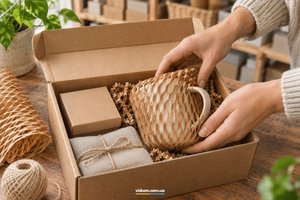
The mailer method works well for flat items. Choose a box when the order mixes print with something bulky: a card with a mug, a calendar with a candle, a gift set. The same goes for framed prints with glass, thick stacks of print and large wholesale orders in several bundles. In those cases the BOPP bag stays as the inner layer that keeps the item looking good, and the box with void fill does the outer work.
Another signal is the value of the order. If it is a limited edition, an original print or a collectible card, a few extra minutes on sturdier packaging pay off in peace of mind and fewer returns.
What to plan for in the December peak
Before the holidays parcel volumes rise and carriers run at full stretch. Parcels may wait longer in the queue, and the weather brings snow, rain and wet pavements. For print that means two things.
First, moisture. BOPP film does not absorb water, and it is what saves a card if the outer mailer lets some drops in, for instance through a poorly sealed flap. The cardboard stiffener, on the other hand, does not like water, so keep it outside the BOPP bag rather than inside with the card. There is more on protecting parcels from snow and frost in our article on winter parcel packing.
Second, stock. If you sell cards or calendars, count how many BOPP bags and courier bags you need for each format in advance, not when the last pack runs out. Our Black Friday packing checklist helps, and it works for the Christmas rush too.
Frequently asked questions
Can I mail a card in a courier bag without a board?
You can, but the risk of creasing is high. A courier bag protects against dust and moisture, not pressure. If the card must arrive flat, use a stiffener.
Can the board go inside the BOPP bag?
Yes, if the bag has enough room for the size and thickness. But then the board sits right next to the card, and if the mailer gets wet the moisture can spread to the item. It is safer to keep the board outside, between the BOPP bag and the mailer.
Which BOPP bag fits a 4×6 photo?
Not the 100×150 mm one: it matches the photo size and leaves no clearance. A 150×200 mm bag is easier, especially if the photo has a mount or an envelope.
Can a BOPP bag be resealed?
The adhesive flap survives a few openings, so you can check the contents and close it again. It is not an everyday zip, though, and not a tamper-evident seal.
Are coloured courier bags suitable for branded shipments?
Yes. Besides white, the range includes grey and coloured mailers in selected sizes. If the contents must not show through, check the opacity of the specific model: colour alone does not guarantee it.