For an online shop, winter is not just the season of gifts and peak sales. Parcels sit longer in unheated depots and sorting hubs, travel in cold vans, get carried through snow by couriers, and in the warehouse cartons soak up moisture next to open dock doors. Packaging that works perfectly in summer can let you down between November and February: cardboard goes soft, tape peels off, fragile items crack and liquids freeze. In this guide we explain how to pack parcels in winter so that goods arrive dry and intact, and which materials you actually need.
The tips are useful for shops selling cosmetics, electronics, tableware, books, clothing and handmade products, and for warehouses that ship orders every day, in hard frost and in thaw alike.
What threatens a parcel in winter
Before choosing materials, it helps to know exactly what you are protecting the goods from. There are five winter risks:
- Moisture and snow. Wet snow, slush and puddles at unloading points damage cardboard more than anything else. Corrugated board that has absorbed moisture loses its stiffness: the box sags under other parcels, corners crush and the shipping label smudges.
- Condensation. When a cold parcel is brought into a warm room, dew forms on the product and inside the box. For electronics, paper, textiles and cosmetics this is as much of a threat as snow on the outside.
- Frost. Plastics become more brittle in the cold, and water-based liquids can freeze. Water expands by about 9% when it freezes, so a completely full bottle may crack or push its cap off.
- Temperature swings. A parcel moves from warm to cold and back several times: warehouse, van, hub, pick-up point, home. Every cycle means fresh condensation and extra stress on the adhesive.
- Peak-season handling. In December there are more parcels, they are stacked higher and handled faster. Weak packaging fails more often during this period.
The three-layer principle: moisture, cushioning, closure
The most reliable winter packaging has three layers, each with its own job. If one layer is missing, the others cannot make up for it.
Layer 1. Moisture protection
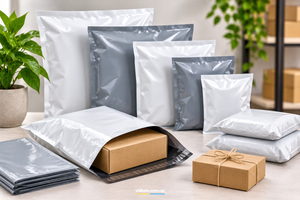
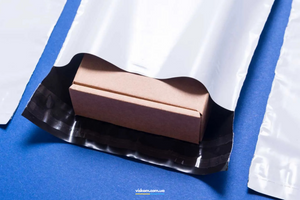
Products that are sensitive to water (clothing, books, electronics, cosmetics in paperboard cartons) first go into a polyethylene bag that is sealed tightly. For small shipments that don't need a box, polyethylene courier mailer bags with a self-seal flap are a good choice: they keep out moisture and snow regardless of the weather. For fragile items, the bag stays as the inner layer, while the box and void fill provide impact protection.
Layer 2. Cushioning and void fill
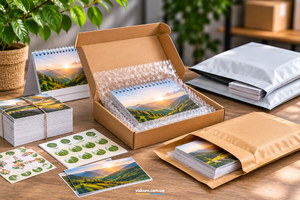
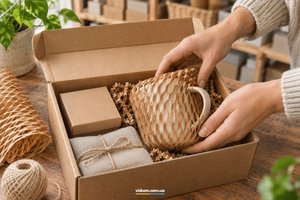
In winter, goods need to be held in the box even more securely than in summer: cold plastic and glass handle impacts worse, and high peak-season stacks press harder. Fill empty space with air cushions, honeycomb paper or paper void fill so the product cannot move or touch the box walls. A bonus of the cushioning layer in winter is that it creates an air gap between the product and the cold carton wall and slightly softens temperature swings.
Layer 3. A strong box and a secure seal
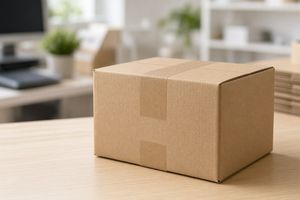
The outer layer is a correctly sized corrugated box and a tape that will not peel off in the cold. The box should be dry and not oversized: extra volume means more void fill, a higher risk of crushing and higher shipping costs. Seal the seams completely, with no gaps where meltwater could seep in.
How packaging materials behave in freezing weather
Not all materials react to cold and moisture in the same way. Here is a quick cheat sheet for packers:
| Material | What happens in winter | How to use it |
|---|---|---|
| Corrugated board | Absorbs moisture and loses stiffness, especially at the corners | Store warm and dry, protect the product with a bag inside, seal all seams |
| Air cushions (HDPE film) | Unaffected by moisture; air pressure inside drops slightly in the cold | Inflate firmly and pack without large gaps |
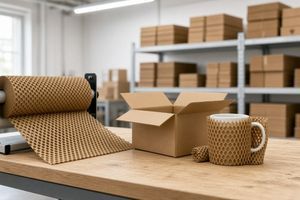
| Honeycomb paper | Cushions well but, like any paper, should not get soaked | Use inside the box; put moisture-sensitive goods in a bag |
| Paper void fill | Keeps its shape in a dry box | Fill voids tightly so the product cannot shift |
| Water-activated kraft tape | The adhesive penetrates the board fibres; on wet or frosty board the bond is weaker | Apply to dry boxes at room temperature |
| Self-adhesive kraft tape | HotMelt adhesive; temperature range on the product page −20 to +60 °C | Apply in a heated room and rub down firmly |
Tape in winter: water-activated or self-adhesive?
The most common winter complaint is "the box came open in transit". Usually the cause is not the tape itself but where and how it was applied.
Water-activated kraft tape (gummed tape) uses a starch-based adhesive. Once moistened, the adhesive penetrates the surface of the carton and bonds with it, so a box sealed this way cannot be opened without visible damage. This holds true in the cold and in high humidity, on one condition: the cardboard must be dry and warm when you seal it. If boxes come straight from an unheated store or are covered with frost, the moisture stops the adhesive from soaking in and the bond stays superficial. So bring boxes into the packing area in advance and keep the water in your tape dispenser at room temperature rather than straight from a cold room. For heavy boxes choose reinforced tape; we explain how to match it to box weight in our article on reinforced gummed tape.
Self-adhesive paper tape is handy where you have no dispenser or water. For example, the 48 mm × 50 m tape has a HotMelt adhesive, and its product page lists a temperature range of −20 to +60 °C. The cold does not make this tape unusable, but any pressure-sensitive adhesive grabs less well if the tape and box are chilled before application. The rule is the same: tape in the warm, then rub the tape down firmly by hand or with a dispenser. A detailed comparison of both tape types is in our guide "Water-activated vs self-adhesive kraft tape".
AirWave air cushions in the cold
Air cushions are almost entirely air, so they are not affected by moisture and add virtually no weight to the parcel. AirWave film is made from HDPE, and the perforated sections tear off easily to pack around the product. In winter, remember simple physics: the colder the air, the lower its pressure inside a sealed cushion. If cushions were inflated in a warm packing room and the parcel then ends up out in the frost, they become slightly softer. So in winter inflate cushions firmly and fill the box so the product has no free play even if the cushions lose a little firmness.
If you pack a lot of orders, it pays to make air cushions on site with a machine. We calculated how much time and money this saves at 50, 200 or 1,000 orders a day in "AirWave air cushion machine: when does it pay off".
Viskom materials for winter packing
These products from the Viskom catalogue cover every layer of winter packaging:
- Moisture protection: polyethylene courier mailer bags for clothing, textiles, documents and other goods that don't need a box.
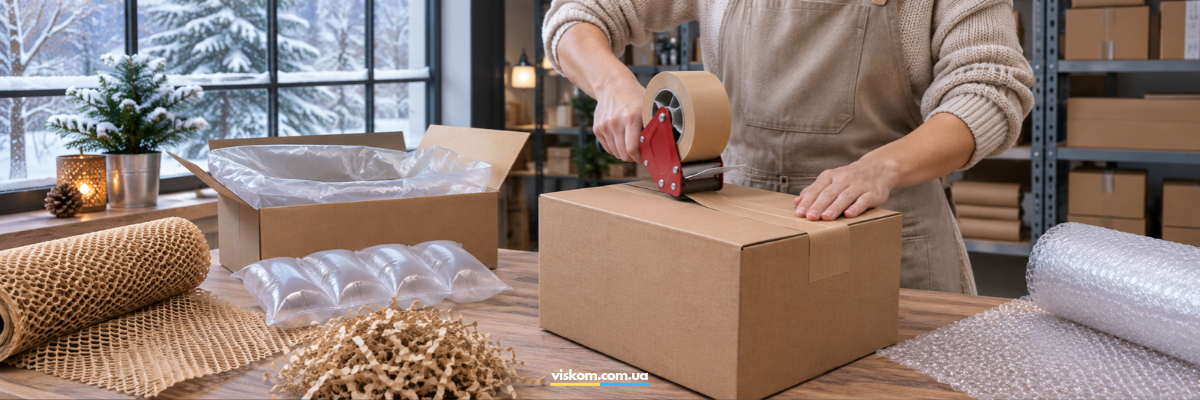
- Cushioning: AirWave air cushions for void fill, Honeycomb kraft paper for wrapping fragile items, Bubble Paper and paper void fill for boxes.
- Boxes: cardboard shipping boxes in different sizes for e-commerce.
- Sealing: water-activated kraft tape, self-adhesive kraft tape and tape dispensers.
To find out how much honeycomb paper one order takes and how to avoid overusing it at peak times, see our calculation "How much honeycomb paper do you need per order".
Products that are especially sensitive to cold
Liquids, creams and cosmetics
Can you ship liquids in freezing weather? Yes, if you prepare them properly and follow your carrier's rules. Water-based liquids can freeze and expand, so don't fill bottles right to the top. Secure caps with tape, put each bottle in its own sealed bag, then wrap it in honeycomb paper or Bubble Paper and fix it firmly in the box. Emulsions such as creams and sauces can separate after freezing: if the manufacturer states a minimum storage temperature, let the customer know and, where possible, offer home delivery so the parcel spends less time in transit.
Electronics
Condensation is the main enemy of electronics in winter. Put the device in a sealed bag and surround it with a cushioning layer of air cushions or honeycomb paper. In a packing note or shipping notification, ask the customer not to unpack or switch on the device straight away, but to leave the box somewhere warm for a few hours so the temperature can even out.
Glass, ceramics and plastic
Plastics become more brittle in the cold and glass handles impacts less well. Wrap each item separately so items don't touch each other or the box walls. Fragile goods are best double-boxed, or packed with at least a few centimetres of cushioning on every side.
Paper, books and textiles
These products don't mind frost, but they really don't like moisture. A bag or mailer as the inner layer is a must, and the box should be sealed along every seam.
Winter warehouse checklist
- Store materials somewhere warm. Keep boxes, tape and film in a heated area away from the dock doors. Cold cardboard and cold adhesive are the main reasons parcels come unstuck.
- Move the packing area away from the doors. Packing benches shouldn't stand in a draught, and finished parcels shouldn't sit on the floor next to an open loading dock.
- Keep everything dry. Snow on clothing, trolleys and pallets melts quickly. Put finished boxes on pallets or shelving, not on the floor.
- Check the box before sealing. If the board feels damp, use a different box.
- Seal the seams completely. For heavy boxes use reinforced tape and an H-pattern seal.
- Protect the label. A smudged label means a lost parcel. Stick it on a flat, dry surface, not over a seam.
- Stock up early. Demand for packaging rises in December. You'll find a purchasing plan in our Black Friday packing checklist.
What to tell your customers
A couple of lines in an email or text message will head off most winter questions and complaints:
- collect the parcel from the parcel locker or pick-up point as soon as possible so it doesn't sit in the cold;
- don't open a cold box containing electronics or cosmetics immediately; let it warm up first;
- if the box is wet or damaged, photograph it before opening and contact the shop.
Frequently asked questions
How do I pack a parcel in winter so it doesn't get wet?
Use three layers: the product in a sealed bag, cushioning and void fill in a dry box, and fully sealed seams. For small, non-fragile items a polyethylene courier mailer bag is often enough.
Does kraft tape hold in freezing temperatures?
Yes, if it is applied correctly. Water-activated tape bonds with the fibres of dry cardboard, and the product page of the 48 mm × 50 m self-adhesive paper tape lists a temperature range of −20 to +60 °C. The key is to seal dry boxes in a heated room.
Can I ship liquids in winter?
Yes, within your carrier's rules. Leave room in the bottle for expansion, secure the cap, place the bottle in a sealed bag and fix it firmly in the box with cushioning material.
Do air cushions deflate in the cold?
They don't deflate, but in frost the air pressure inside drops slightly and the cushion feels softer. That's why in winter they should be inflated firmly and the box filled without large gaps.
Conclusion
Winter packaging doesn't call for expensive solutions: protect the product from moisture, hold it firmly with cushioning material and seal a dry box with tape applied in the warm. Warehouse organisation does the rest: materials are stored in a heated area, packing benches stand away from the doors, and customers know how to handle a cold parcel. If you need help choosing void fill, boxes or tape for the winter season, get in touch with the Viskom team.