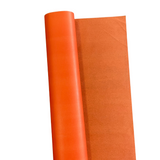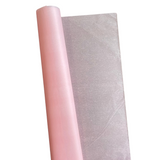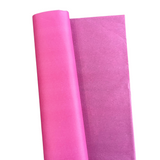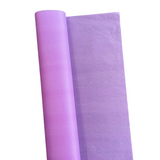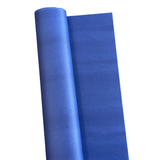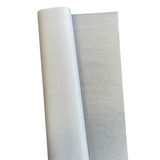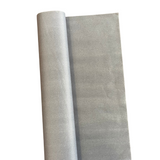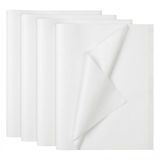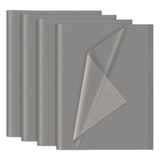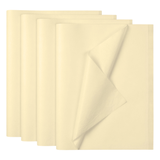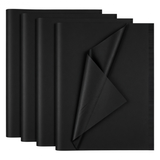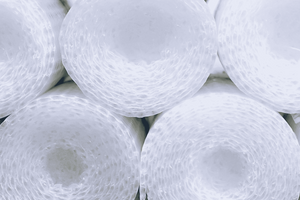
Tissue paper is a thin packaging paper for wrapping goods, presenting gifts and lining boxes. It is used for clothing, accessories, cosmetic sets and decorative arrangements. It helps separate an item from other packaging elements and gives the order a neat look.
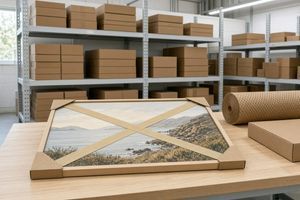
For shipping glass, ceramics or candles in glass containers, tissue should be combined with a suitable shipping box and protective materials. A thin decorative layer on its own does not provide enough protection against impacts.
What tissue paper is used for
- Clothing and textiles. For wrapping folded items and separating the elements of an order inside the box.
- Gift sets. For lining the bottom, covering the contents and adding a colour accent at unboxing.
- Accessories and handmade items. As an intermediate packaging layer. For delicate finishes, first check material compatibility on a sample.
- Cosmetics and candles. For presenting closed containers or an individual small box. Glass containers need additional protection.
- Decor and crafts. For paper flowers, pom-poms and decorative inserts.
Tissue can be crumpled to create decorative volume. However, this should not be considered a universal way of securing heavy or fragile items. Choose the protection scheme according to the weight, shape and material of the product.
How to choose tissue paper for packaging
Sheet size
First, measure the item or the internal dimensions of the box. The sheet should be large enough for the planned wrapping and edge overlap. Do a test wrap: this will show whether you need a whole sheet, part of one or several sheets.
For example, Viskom stocks white tissue paper 50 × 70 cm, 30 sheets. The product page for this item states a grammage of 23 g/m². These are the specifications of that particular item, not of all tissue paper.
Colour and contact with the product
White is easy to combine with different designs, while coloured tissue can be matched to the box, ribbon or brand palette. Before using coloured paper with white textiles or sensitive finishes, test on a sample whether it leaves marks. Do not assume dye fastness from the colour name alone.
Special properties
The label "tissue" does not in itself confirm that the paper is acid-free, water-resistant or suitable for direct contact with food. If you need these properties, check the documentation for the specific material you choose. For long-term storage of valuables, paper requirements should be clarified separately.
How to wrap an item in tissue: step by step
- Prepare a clean, dry surface. Lay out the sheet and check its size by test fitting.
- Position the item. For wrapping, leave enough paper on both sides so that the edges overlap without pulling too tight.
- Fold the edges. Carefully fold the sides and ends. If the paper tears, reconsider the sheet size and folding method.
- Secure the paper if necessary. Apply a sticker to the paper, avoiding contact between the adhesive and the item.
- Place it in the box. Add suitable protective padding or void fill if the item needs securing.
- Check the result. Make sure the box closes without excessively compressing the contents. For fragile goods, check the whole packing scheme, not just the decorative layer.
For glass and ceramics, see also our step-by-step guide to packing fragile goods.
How many sheets you need per order
There is no universal norm: consumption depends on the size of the item, the folding method and the number of layers. Determine it with a test wrap and then calculate your purchase.
Number of sheets = number of orders × sheets used per order.
Hypothetical example: one order needs 2 sheets, and 100 orders are planned. So 100 × 2 = 200 sheets. If a pack contains 30 sheets, then 200 ÷ 30 = 6⅔ packs. For purchasing, round up to 7 packs: 7 × 30 = 210 sheets. The remainder is 210 − 200 = 10 sheets.
Determine any extra allowance for offcuts or defects from your own measurements. You can account for the consumption of other materials and labour time using the method for calculating the packaging cost of one order.
Frequently asked questions
How is tissue different from kraft paper?
Tissue is usually chosen for light wrapping and decorative layers. Wrapping kraft paper is for other packing schemes, depending on its grammage and specifications. Compare strength and consumption using specific materials and the same product.
Can flowers be wrapped in tissue?
It can be used as a decorative layer. If the paper may come into contact with water or wet stems, you need a material with confirmed suitability for such conditions or an appropriate insulating layer.
How should the sheets be stored?
Keep the paper in a dry, clean place, protected from moisture, dust and dirt. Store the sheets flat to avoid unwanted creases before packing.
Where to choose tissue paper
Browse tissue paper in the Viskom catalogue: compare colours, sheet sizes, quantity per pack and the specifications of the selected item. Before a large purchase, test the material on your own product and determine actual consumption.
Updated 21 October 2026. The specifications of the example given were checked against the Viskom product page on the date of the update.
Read more on this topic: Packaging gift sets and candles: materials that create a WOW effect and protect the product.
Read also: