Humanity has needed to store and transport all kinds of items since ancient times. Primitive people used natural materials such as plant leaves, tree bark and woven baskets to gather and store food. The development of trade between tribes and peoples created demand for reliable containers that could protect goods in transit. Archaeological finds show that special vessels for storing water, grain and other valuable resources already existed in the Stone Age. Gradually, humanity mastered new materials and technologies, creating ever more sophisticated ways of packing goods. Each historical era brought unique solutions that reflected the level of technology of its time.
Ancient civilisations and the flowering of the packaging craft
The Egyptians were the first to start mass production of specialised containers. They made clay amphorae of various sizes, each intended for a particular type of goods. Special marks were applied to the vessels to indicate their contents and origin. Phoenician seafarers improved the design of amphorae, making them more stable in rough seas. The first paper packaging appeared in ancient China and gradually spread around the world along the trade routes. The Roman Empire brought the production of ceramic containers to an industrial scale: archaeologists find entire storehouses holding thousands of amphorae. Medieval craftsmen developed the art of glassblowing, which led to glass bottles and jars. The cooper's craft reached its peak, producing sturdy wooden barrels for storing a wide variety of goods.
Revolutionary changes and the path to innovation
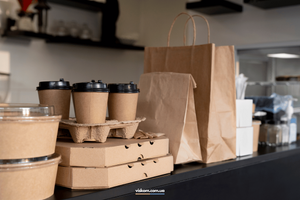
With the start of the Industrial Revolution, packaging production reached a new level. Mechanisation made mass production of standardised containers possible. The invention of the tin can at the beginning of the 19th century revolutionised food storage. The development of the chemical industry led to new materials with unique properties. Today Viskom offers a wide range of packaging materials in Kyiv and other Ukrainian cities at reasonable prices. Modern packaging is designed with the following important factors in mind:
- Ability to protect the contents from mechanical damage
- Resistance to moisture and temperature fluctuations
- Optimal ratio of weight to material strength
- Ease of transport and storage
- Suitability for automated production
- Environmental safety and recyclability
- Cost-effective production
Each of these factors plays an important role in developing packaging solutions. Manufacturers strive to find the optimal balance between functionality, cost and eco-friendliness. Modern technologies make it possible to create materials with specified properties that meet the strictest safety requirements.
The history of packaging clearly shows the evolution of human ingenuity and technical progress. From the simplest natural materials to high-tech solutions, each stage of development reflects society's needs and the possibilities of production. Millennia of improvement have produced a huge variety of packaging materials, each with its own unique properties and uses. The drive for sustainability and efficiency remains the main engine of innovation in the packaging industry. Technological progress opens up new prospects for ever more advanced solutions for packing and storing goods.
Read more on this topic: types of packaging materials.
Read also:
- The History of Disposable Paper Tableware
- Who Invented Scotch Tape, How and Why: The History of Adhesive Tape
- Who Invented Gift Wrapping and Why Do We Love It So Much?
Related products: packaging materials catalogue.