A pallet looks like the simplest thing in a warehouse: a wooden base, boxes on top, film around it. Yet pallets are where things most often go wrong in transit: boxes slide, top layers fall and bottom layers get crushed under the weight. Three things decide the outcome: the right pallet, an evenly distributed load and secure fixing. Let us go through each of them.

Step 1. Choose the pallet
Size is only the first thing to consider. The most common formats are 800 × 1200 mm, 1200 × 1000 mm and 800 × 600 mm. Next, estimate how many pallets a specific job needs so that as little empty space as possible remains in the truck or container, and how much weight the pallet must carry. Take into account both the static load (when the pallet is standing) and the dynamic load (when it is lifted, moved and braked).
Wooden pallets
The classic choice and the most widely used. But wood absorbs moisture and gets damaged over time, so for damp conditions or repeated circulation a wooden pallet is not always the best option.
Plastic pallets
They do not absorb moisture and are hard to damage, which makes them well suited to storing and transporting heavy loads. There are versions with a smooth top and a protective rim around the edge, as well as versions with rubber pads that stop the pallet sliding in the truck. For the food and pharmaceutical industries, pallets are made from food-contact material: they are easy to wash and disinfect, so there is no risk of mould. Before switching to plastic, think about what the pallets will be used for and in what conditions.
Pressed and cardboard pallets
An alternative to solid wood: pallets made of pressed sawdust or cardboard. According to their manufacturers, pressed pallets take up about two thirds less storage space than standard wooden or plastic ones, which is why they are chosen, among other things, for air freight. Cardboard pallets are noticeably lighter than wooden ones, which reduces the total weight of the shipment, and empty ones are easy to move without a forklift.
Step 2. Distribute the load evenly
The stability of the whole pallet depends on how the load is distributed. Typical mistakes are light boxes under heavy ones, or light boxes on one side of the pallet and heavy ones on the other. The rules are simple:
- put the heaviest packages at the bottom and lighter ones on top;
- spread the weight evenly over the whole pallet so the centre of gravity is in the middle;
- place boxes as tightly together as possible: any gap gives the load room to move;
- if a layer has empty space, plan the layout in advance or fill the gap;
- standard-sized boxes and pallets are much easier to stack in a way that uses all the available space.
To stop layers sliding over each other, anti-slip paper is placed between them and on the pallet itself: it keeps boxes and sacks in place and serves as an interlayer at the same time.
Step 3. Secure and protect the pallet

Even a perfectly stacked load will not be fully stable in transit without protection. Start with the corners: edge protectors shield the box edges from impacts and from the pressure of the film. Then the pallet is wrapped in film, by hand or with packaging equipment.
Stretch film: how to wrap properly
Stretch film is the most common choice for mixed loads on pallets. Its main advantage is elasticity: the film stretches, hugs the load and compresses the boxes into one block. The second advantage is that the layers cling to each other, so no air pockets form between them that would let the film stretch and weaken. A few practical tips:
- Start at the bottom. For extra security, catch one of the pallet feet in the film so that the load and pallet become one unit.
- Make several turns at the base before moving up. This makes the pallet more stable.
- Pull the film tight at the corners. As you move from corner to corner, stretch the film slightly so the load is firmly compressed.
- Overlap the turns and finish at the top so the top layer of boxes is secured too.
Stretch film comes in hand and machine versions, 17 to 35 microns thick. We explained how to choose the thickness and width for your load in the article “How to choose stretch film for pallets”. Do not confuse it with shrink film: that is not stretched but placed over the pallet and shrunk with heat. Read about that option in the article “Shrink hoods for pallet packaging”.
If the load needs to be hidden from view, opaque film is used, and coloured film also helps to identify and sort pallets quickly in the warehouse. For vegetables, fruit and other products that need ventilation, pallet netting works instead of film: it stretches by 150–250%, holds the load and lets air through.
Pallet wrapper
When there are many pallets every day, wrapping them by hand is tiring and the result depends on the person. Pallet wrappers are especially useful for unstable loads and loads of non-standard size. There are stationary vertical models, rotating-arm models and self-propelled machines that drive around the pallet. Self-propelled models have no limits on pallet weight or dimensions and take up little space. More in the article “What a pallet wrapper is for”.
Step 4. Secure the pallets in the truck
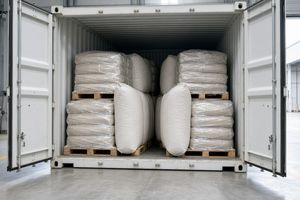
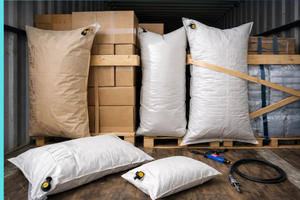
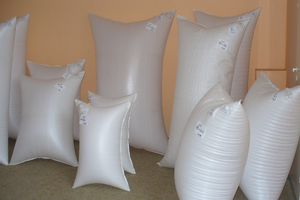
Even a well-wrapped pallet can shift if there are gaps between pallets in the truck or container. These are filled with dunnage bags: the bags are placed in the gaps and inflated, bracing the load and absorbing jolts. Dunnage bags suit gaps from 10 to 60 cm wide and can be reused. Other load securing equipment, such as locking bars and spreader bars, keeps pallets from shifting in the truck. We explained how to choose them for your vehicle in the article “How to secure cargo properly”.
The summary is simple: the right pallet, heavy at the bottom, boxes tight together, corner protectors, film from bottom to top under tension and no gaps in the truck. Then the pallet will arrive as straight as it left the warehouse. And to move finished pallets around the warehouse, you will need pallet trucks.