Warehouses and online shops rarely buy an air cushion machine because it looks modern. They buy it when void fill starts to show up in the cost per order, slows down the packing bench and eats warehouse space. Yet the equipment costs anywhere from tens of thousands to over a hundred thousand hryvnias, so before signing off on the purchase every owner asks the same question: how many months until the investment pays for itself? This article is not a material comparison. It is a payback calculation: a transparent ROI formula, real prices from the Viskom catalogue and three scenarios — 50, 200 and 1,000 orders a day.
If you are looking for a comparison of protective properties, read “Bubble Wrap vs AirWave: Which Is Better for Protecting Cargo?”. Here we focus on the numbers.
What Viskom offers: machines and film
All prices and specifications below are taken from the product pages in the AirWave air cushion packaging section as of the publication date. Prices on viskom.com.ua are in Ukrainian hryvnias (UAH) and may change, so check them on the site before you run your own numbers.
- AirBoy Nano 4 — 30,680 UAH. Output 10 m/min, weight 2.5 kg, film types 9.7.1 and 9.8.3. According to the manufacturer's description, it can serve 2 workstations at once.
- AirWave 1 — 62,400 UAH. Output 8–10 m/min, weight 5.6 kg, film thickness 12–30 microns, volume sensor for automatic start and stop. According to the description, it serves up to 4 workstations at once.
- AirWave 2 — 113,880 UAH. Output up to 22 m/min, weight 6.5 kg, film thickness 12–30 microns.
All three machines are made by the German company FLÖTER Verpackungs-Service GmbH. The consumable is a roll of film with perforated sections that the machine inflates and seals:
| Film | Section size | Roll | Sections per roll | Roll price | Price per cushion* |
|---|---|---|---|---|---|
| AirWave 7.1 | 100 × 210 mm | 700 m, 4.3 m³ of void fill | 7,000 | 4,044 UAH | ≈ 0.58 UAH |
| AirWave 9.7.1 | 100 × 210 mm | 350 m, 2.15 m³ of void fill | 3,500 | 2,856 UAH | ≈ 0.82 UAH |
| AirWave 8.3 (mats) | 420 × 320 mm | 450 m | 1,406 | 5,760 UAH | ≈ 4.10 UAH |
| AirWave 9.8.3 (mats) | 420 × 320 mm | 225 m | 703 | 3,024 UAH | ≈ 4.30 UAH |
* We calculated the price per cushion ourselves: roll price ÷ number of sections. The AirBoy Nano 4 page lists film types 9.7.1 and 9.8.3; ask a Viskom manager which film series fits AirWave 1 and AirWave 2 before you order.
What payback is made of
A machine does not pay for itself on its own. It pays back through the difference between what packing an order costs today and what it will cost with air cushions. The easiest way is to calculate that difference per order and then multiply it by your order volume.
What your current void fill costs
Take your actual invoices for the last 1–3 months: paper, bubble wrap, corrugated board, loose fill or whatever you use. Divide the total by the number of orders shipped in the same period. The result is Cnow — your void fill cost per order. If you have not broken down your full packaging cost yet, see “How to Calculate the Packaging Cost of One Order”.
What air cushions will cost
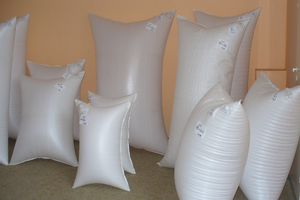
Count how many cushions a typical order needs. The most reliable way is to pack 20–30 real orders and write the number down. Then Cair = number of cushions × price per cushion. On 7.1 film one cushion costs about 0.58 UAH, on 9.7.1 about 0.82 UAH. If you prefer to think in volume: one 7.1 roll yields 4.3 m³ of void fill, roughly 0.94 UAH per litre; one 9.7.1 roll yields about 1.33 UAH per litre.
How much packing time you save
Air pillows come out of the machine as a ready-to-use chain: no crumpling, cutting or measuring. Whether that actually saves time on your bench is something to check with a stopwatch: time 20 orders with your current void fill and 20 with air cushions. The difference in minutes per order is Δt. Multiply it by the fully loaded hourly cost of a packer — W.
The payback formula
Saving per order S = (Cnow − Cair) + Δt × W ÷ 60
Payback (months) = machine price ÷ (S × orders per month)
If S comes out at zero or below, the machine will not pay back through void fill savings alone. Then the deciding factors are the other ones: warehouse space, parcel weight and damage rates. More on them below.
The calculation for 50, 200 and 1,000 orders a day
For all scenarios we assume 22 working days a month and, as an example only, 6 cushions of 100 × 210 mm per order. This is a teaching assumption, not a standard: an accessories shop may need 2 cushions, a tableware shop 12. Plug in your own figure.
Film and machine time required
| Orders per day | Orders per month | Cushions per day | Film per day | Machine time at 10 m/min | 7.1 rolls per month | 9.7.1 rolls per month |
|---|---|---|---|---|---|---|
| 50 | 1,100 | 300 | 30 m | ≈ 3 min | ≈ 0.9 | ≈ 1.9 |
| 200 | 4,400 | 1,200 | 120 m | ≈ 12 min | ≈ 3.8 | ≈ 7.5 |
| 1,000 | 22,000 | 6,000 | 600 m | ≈ 60 min (≈ 27 min at 22 m/min) | ≈ 18.9 | ≈ 37.7 |
The table shows something that is easy to miss: even 1,000 orders a day is only about an hour of actual machine run time. The bottleneck is not inflation speed but the number of packing stations the cushions have to reach. That is why the more important spec is how many workstations a machine can serve at once.
Minimum saving per order for a 12-month payback
This table needs no assumptions about your current void fill: Smin = machine price ÷ (orders per month × 12). If your real saving per order is higher, the machine pays back in less than a year.
| Orders per day | AirBoy Nano 4 (30,680 UAH) | AirWave 1 (62,400 UAH) | AirWave 2 (113,880 UAH) |
|---|---|---|---|
| 50 | 2.32 UAH | 4.73 UAH | 8.63 UAH |
| 200 | 0.58 UAH | 1.18 UAH | 2.16 UAH |
| 1,000 | 0.12 UAH | 0.24 UAH | 0.43 UAH |
In other words, a shop shipping 200 orders a day only needs to save 1.18 UAH per order for AirWave 1 to pay back within a year. At 50 orders a day the same AirWave 1 needs a saving of 4.73 UAH per order.
Worked example with illustrative numbers
The following is an illustrative example. We made up the current-cost figures to demonstrate the method; they are not Viskom data or market averages. Replace them with your own.
- Current void fill: 6 UAH per order (illustrative).
- 6 cushions per order: 3.47 UAH on 7.1 film, 4.90 UAH on 9.7.1 film (at site prices).
- Time saved: 0.5 min per order (illustrative), packer cost 120 UAH per hour (illustrative), i.e. 1 UAH per order.
That gives S = 6 − 3.47 + 1 = 3.53 UAH for AirWave 1 and 2 (7.1 film) and S = 6 − 4.90 + 1 = 2.10 UAH for AirBoy Nano 4 (9.7.1 film).
- 50 orders a day: AirBoy Nano 4 — 30,680 ÷ (2.10 × 1,100) ≈ 13 months; AirWave 1 — 62,400 ÷ (3.53 × 1,100) ≈ 16 months.
- 200 orders a day: AirBoy Nano 4 ≈ 3.3 months; AirWave 1 ≈ 4 months.
- 1,000 orders a day: AirWave 2 — 113,880 ÷ (3.53 × 22,000) ≈ 1.5 months; two AirWave 1 units for separate packing zones ≈ 1.6 months.
With these illustrative numbers the picture is clear: at 50 orders a day payback takes more than a year, at 200 a few months, at 1,000 under two months. But if your current void fill is cheaper than air cushions and there is no time saving, small volumes may take much longer. That is why you should always run the calculation with your own figures.
Which machine fits your volume
Up to 50–100 orders a day
Here a low entry price matters most. The AirBoy Nano 4 costs half as much as the AirWave 1, weighs 2.5 kg and, according to its description, serves 2 workstations. 9.7.1 film is more expensive per cushion, but a 350 m roll takes little space and is used up in weeks rather than months.
Around 200 orders a day
Both options work. With 1–2 packers, the AirBoy Nano 4 is enough. With 3–4 packing tables and peak days at double volume, the AirWave 1 makes more sense: it is designed for 4 workstations and, in our calculation, runs on film that is cheaper per cushion (confirm compatibility with a manager).
1,000 orders a day and more
At this volume even a few kopecks saved per order add up to thousands of hryvnias a month. The choice between one AirWave 2 (22 m/min) and several AirWave 1 units depends on your warehouse layout: one powerful machine feeding a central line, or a separate unit in each packing zone. The second option gives you redundancy: if one machine is being serviced, the others keep running.
For a broader view on how to evaluate returns on warehouse technology, read “Investing in Warehouse Equipment as a Path to Greater Efficiency”.
What the formula does not show
- Warehouse space. A 7.1 roll turns into 4.3 m³ of void fill but takes up the space of a single roll until it is inflated. If you currently store bulky pre-made void fill, the floor space you free up has a price: your rent per square metre.
- Parcel weight. An air cushion weighs next to nothing, so it does not add to shipping weight. With carriers that charge by actual or dimensional weight, choosing the right box matters more — see “Corrugated Boxes for E-commerce: How to Calculate the Size and Save on Shipping”.
- Damage and returns. If air cushions hold the product better in your box, every undamaged parcel saves the product, the shipping and the customer relationship. Add a term to the formula: (damage cases before − after) × average cost per case.
- Flexibility. Cushions are made on demand, so you do not have to buy and store extra void fill ahead of peak season.
We compared air pillows with cardboard void fill for filling empty space in boxes in “How to Fill Empty Space in Boxes: Air Pillows vs Cardboard Void Fill”.
How to test the calculation in your own warehouse
- Calculate Cnow from 1–3 months of invoices.
- Pick 20–30 typical orders and record how many cushions each one needs.
- Time the packing with your current void fill and with air cushions.
- Plug the numbers into the formula for each model and compare payback periods.
- Add what is hard to quantify: floor space, damage, peak seasons.
- Ask a Viskom manager for current prices, availability and film compatibility with the machine you choose.
Frequently asked questions
How long does it take for an air cushion machine to pay off?
There is no universal answer: it depends on order volume, the cost of your current void fill and the time saved. Use the formula: machine price ÷ (saving per order × orders per month). In our illustrative example it ranges from 1.5 months at 1,000 orders a day to over a year at 50.
How much does one AirWave air cushion cost?
Dividing the roll price by the number of sections listed on viskom.com.ua, a 100 × 210 mm cushion costs about 0.58 UAH on 7.1 film and about 0.82 UAH on 9.7.1 film. Large 420 × 320 mm mats come to about 4.10–4.30 UAH.
Is one machine enough for 1,000 orders a day?
In terms of speed, yes: 600 m of film a day is about an hour of run time at 10 m/min. The limit is how many workstations one machine can serve at the same time. If you have more packing tables than one machine is designed for, plan for several units.
Can any film be used in any machine?
No. For the AirBoy Nano 4 the site lists film types 9.7.1 and 9.8.3. For the AirWave 1 and AirWave 2, check the compatible film series with a manager before ordering.
Conclusion
An air cushion machine is an investment you should calculate, not buy on gut feeling. Work out your saving per order, plug it into the formula and compare it with the minimum-saving table: at 200 or more orders a day payback is usually measured in months; at 50 it depends on how much you spend on void fill today. You can choose AirWave machines and film in the Viskom air cushion packaging catalogue.